

Human Right: Right to an Education
Business Skill: Resilience
QUICK START
UDHR Article(s): Article 26
CRC Article(s): Article 29
Estimated Time per Lesson: 45 minutes
For Each Lesson, You Will Select:
(1) Song
(2) Review Activity
(3) Business Skills Development Activity
(4) Activity [Only Lesson 5B]
(5) Challenge
Objectives: students will
(1) explain why they have a right to education
(2) identify that fundamental education is free and compulsory
(3) understand how resilience will help them face challenges in receiving an education
(4) practice resilient learning through problem-solving activities
Lesson 5A – Right to an Education
Article 26
(1) Everyone has the right to education. Education shall be free, at least in the elementary and fundamental stages. Elementary education shall be compulsory. Technical and professional education shall be made generally available and higher education shall be equally accessible to all on the basis of merit.
(2) Education shall be directed to the full development of the human personality and to the strengthening of respect for human rights and fundamental freedoms. It shall promote understanding, tolerance and friendship among all nations, racial, or religious groups, and shall further the activities of the United Nations for the maintenance of peace.
(3) Parents have a prior right to choose the kind of education that shall be given to their children.
Universal Declaration of Human Rights
Business Skill: Resilience
The ability to remain composed, adaptable, and constructive in the face of setbacks, using challenges as opportunities for growth and continued collaboration.
“Between stimulus and response there is a space. In that space is our power to choose our response. In our response lies our growth and our freedom.”
Stephen R. Covey (2004). “The 7 Habits of Highly Effective People: Powerful Lessons in Personal Change”, Simon and Schuster.
Learning Outcomes
- Students will explain why they have a right to education.
- Students will identify that elementary and fundamental education is free and compulsory.
- Students will understand resilience as an important skill for facing challenges.
Lesson 5A – Right to an Education
Resilience
1. Welcome
2. Review
3. Discussion
For information on handling sensitive topics, see here.
Have a student read UDHR Article 26 (p. 49).
Questions
- Who has the right to education? (Everyone!)
- What are the two requirements in the elementary and fundamental stages of education? (It should be free and compulsory.)
- What does compulsory mean? (Students are required to attend.)
- Why is it important to attend and study? (It helps you achieve your goals and help your community. Higher education acceptance is based on merit. The more you prepare the more chance you have to grow.)
- How does education strengthen us? (It helps us develop our personality. It helps us understand human rights and fundamental freedoms. It helps us become respectful and responsible local and global citizens.)
- Who has the right to choose the kind of education you are given? (Your parents.)
- What makes it hard for some children to go to school?
- What does resilience mean? Write down the key words students say about resilience on the board.
- Can you think of a time you had to bounce back from a setback?
4. Business Skills Development
[Select a business skills development activity.]
5. Conclusion
Discuss the following questions with the class.
Questions
- In what ways might your education help your family, friends, or community?
- What do you need to learn?
- Who can help you learn?
- How can your government help you get an education?
- What can you do if you face challenges in your education?
- How can being resilient help you get the education you have a right to?
6. Challenge
Lesson 5B – Right to an Education
Article 26
(1) Everyone has the right to education. Education shall be free, at least in the elementary and fundamental stages. Elementary education shall be compulsory. Technical and professional education shall be made generally available and higher education shall be equally accessible to all on the basis of merit.
(2) Education shall be directed to the full development of the human personality and to the strengthening of respect for human rights and fundamental freedoms. It shall promote understanding, tolerance and friendship among all nations, racial, or religious groups, and shall further the activities of the United Nations for the maintenance of peace.
(3) Parents have a prior right to choose the kind of education that shall be given to their children.
Universal Declaration of Human Rights
Article 29
1. States Parties agree that the education of the child shall be directed to:
a. The development of the child’s personality, talents and mental and physical abilities to their fullest potential;
b. The development of respect for human rights and fundamental freedoms, and for the principles enshrined in the Charter of the United Nations;
c. The development of respect for the child’s parents, his or her own cultural identity, language and values, for the national values of the country in which the child is living, the country from which he or she may originate, and for civilizations different from his or her own;
d. The preparation of the child for responsible life in a free society, in the spirit of understanding, peace, tolerance, equality of sexes, and friendship among all peoples, ethnic, national and religious groups and persons of indigenous origin;
e. The development of respect for the natural environment.
Convention on the Rights of the Child
Business Skill: Resilience
The ability to remain composed, adaptable, and constructive in the face of setbacks, using challenges as opportunities for growth and continued collaboration.
“Between stimulus and response there is a space. In that space is our power to choose our response. In our response lies our growth and our freedom.”
Stephen R. Covey (2004). “The 7 Habits of Highly Effective People: Powerful Lessons in Personal Change”, Simon and Schuster.
Learning Outcomes
- Students will outline how education is important and strengthens them.
- Students will see how resilience will help them face challenges in receiving an education.
- Students will practice resilience through problem-solving activities.
Lesson 5B – Right to an Education
Resilience
1. Welcome
2. Review
3. Discussion
For information on handling sensitive topics, see here.
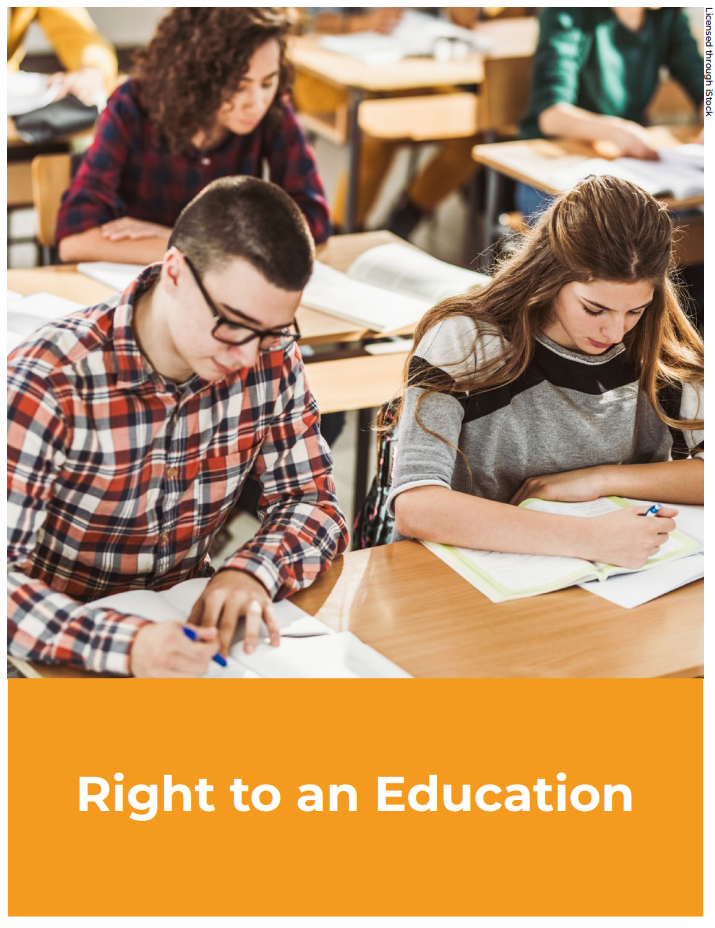
Show the Right to an Education mini poster (see below).
Questions
- What do you see in this photo? (Children at school)
- Who would like to tell us about a time when you learned something that was very important or helpful to you?
- What might be some challenges they face with their education or that you have faced with yours?
- How is resilience important to get an education?How do these articles work together to protect us from harm?
Read CRC Article 29 (see above).
Article 29 of the CRC includes many of the same ideas found in Article 26 of the UDHR. However, Article 29 of the CRC includes several additional points about education.
Question
What are some of the important points in Article 29?
- The development of the child’s personality, talents, and mental and physical abilities to their fullest potential
- The development of respect for human rights, and fundamental freedoms
- The development of respect for the child’s parents, his or her own cultural identity, language and values and for the national values of the country in which the child is living, the country from which he or she may originate, and for civilizations different from his or her own
- Preparation of the child for a responsible life in a free society, in the spirit of understanding, peace, tolerance, equality of sexes, and friendship among all peoples, ethnic, national, and religious groups, and persons of indigenous origin
- The development of respect for the environment
4. Business Skills Development
[Select a business skills development activity.]
5. Conclusion
6. Challenge
Last updated: 06/06/26