

The Overlooked Source of Human Capability and Character
Why faith and belief matter in the age of artificial intelligence. A Board paper on human character, corporate governance and long-term value.
By Brian J. Grim, PhD, with a foreword by Sarah Gillard, CEO of A Blueprint for Better Business. Published by the Religious Freedom & Business Foundation and Faith@Work UK.
Download the white paperRead the case studiesPlan a Board conversation
In an AI-enabled era, the culture of business will matter even more.
Sarah Gillard, CEO, A Blueprint for Better Business. From the foreword.
The argument in brief
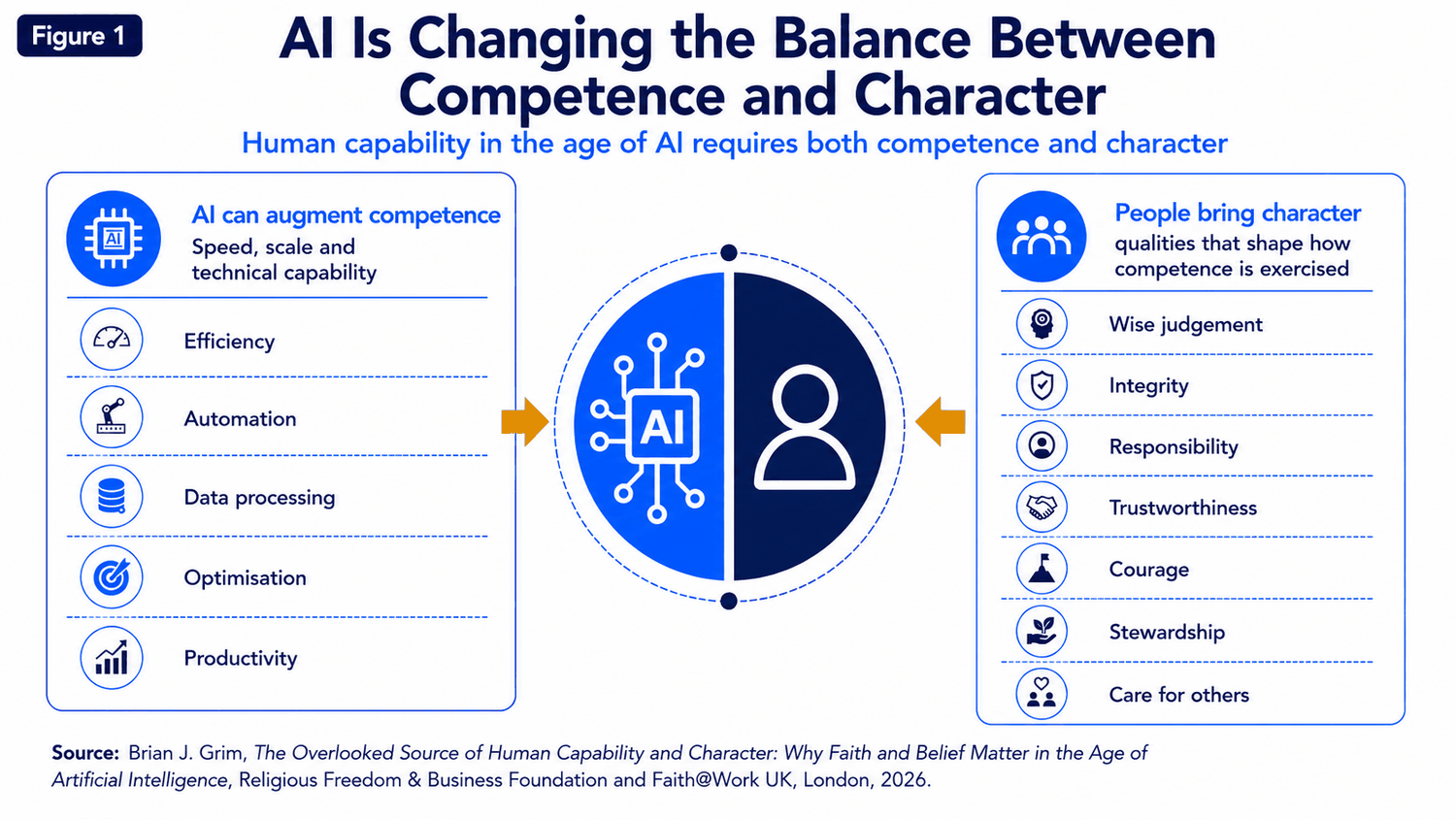
As AI takes on more of what organisations do, the character of the people deciding what they should do becomes more consequential.
AI can augment speed, scale and technical capability. It cannot assume responsibility, determine purpose or exercise judgement on an organisation’s behalf. Organisations depend on wise judgement, integrity, responsibility, trustworthiness, courage, stewardship and care for others. They do not create these qualities from scratch. They are formed and renewed through families, communities, education, experience, service and, for many people, traditions of religion or belief.
The aim is not to make the workplace religious. It is to recognise an overlooked source of character and govern the conditions in which it can contribute to culture, wise judgement and trusted performance.
Watch
The white paper in a few minutes
Brian Grim introduces the argument and the Board questions.
The full webinar discussion
The launch conversation on faith, belief and character in the age of AI.
What the evidence shows
Established but uneven
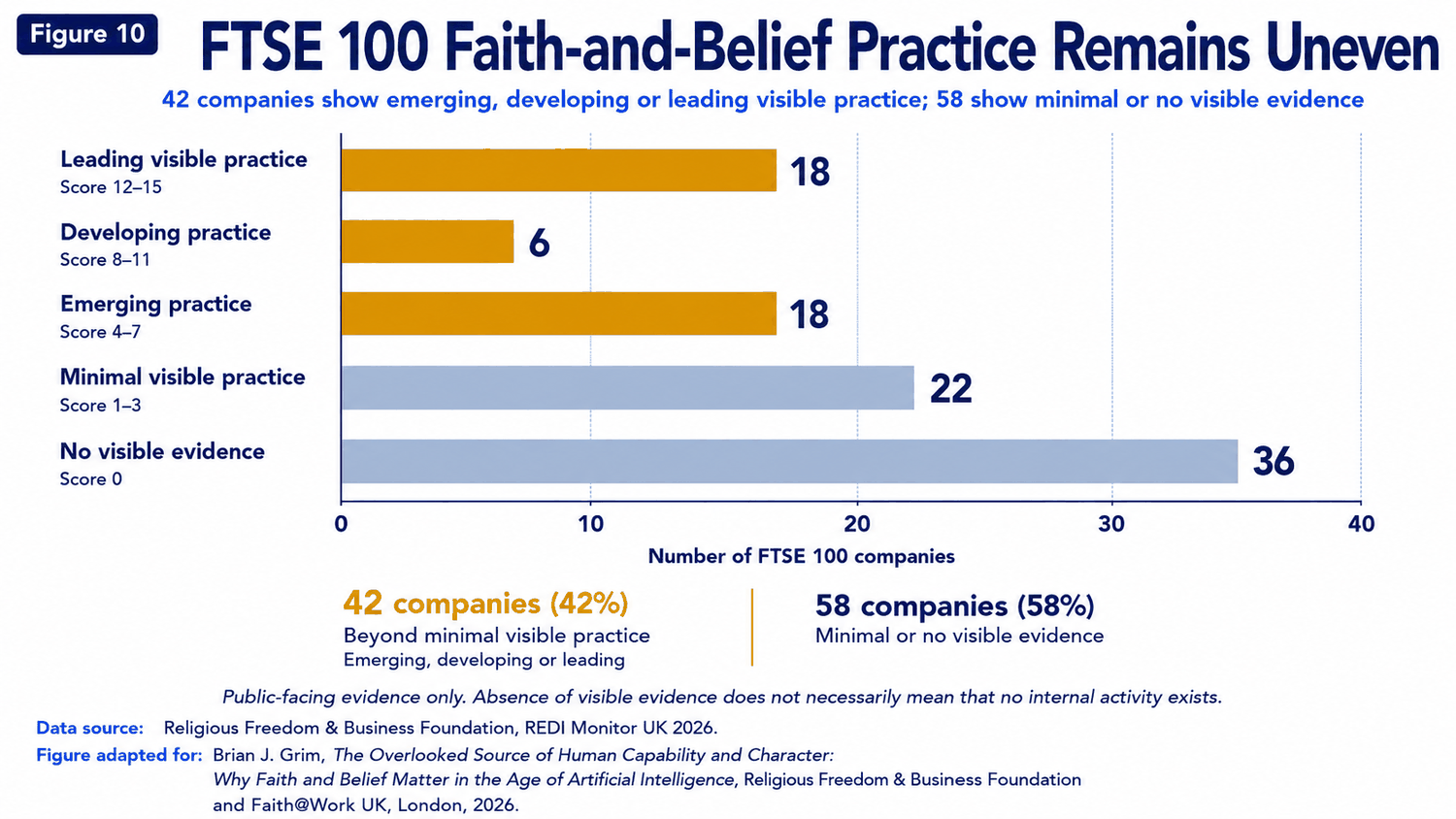
The 2026 REDI Monitor examined public-facing evidence for the FTSE 100. Forty-two companies show emerging, developing or leading practice, including 18 with leading practice. A further 22 show minimal visible practice and 36 show no visible evidence. The Monitor cannot capture every internal activity, but the pattern is clear: meaningful practice is possible, but far from consistent.
Five ways faith or belief becomes organisational capability
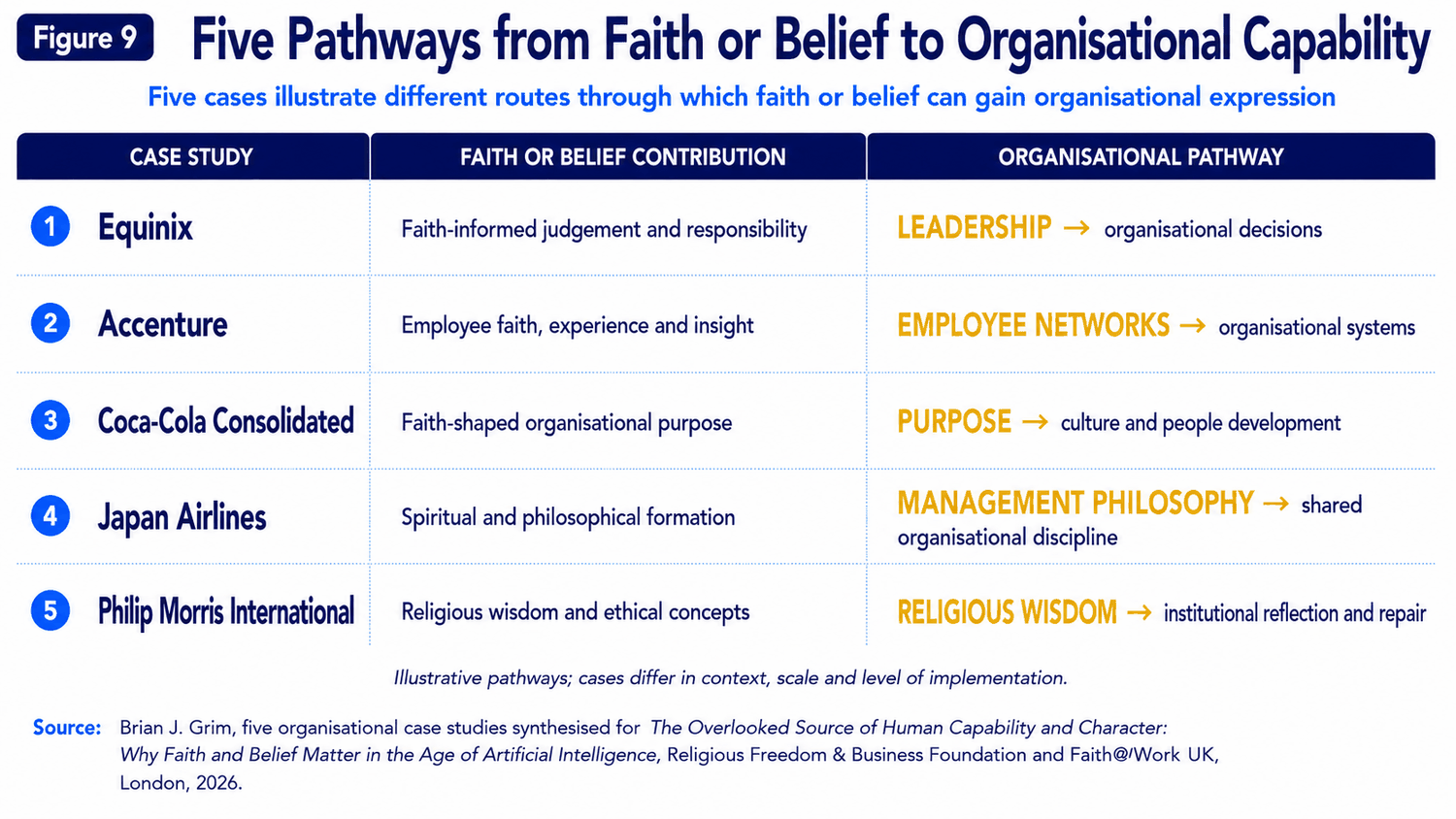
The case studies show there is no single route. Translation can begin with leadership, employee networks, organisational purpose, management philosophy or intentional engagement with religious wisdom.
Source for all figures: Brian J. Grim, The Overlooked Source of Human Capability and Character: Why Faith and Belief Matter in the Age of Artificial Intelligence, Religious Freedom & Business Foundation and Faith@Work UK, London, 2026.
What is inside
Fifteen short sections in five parts. Open any part for the key points.
1 to 5. From competence to culture and enterprise value
AI is changing the balance between competence and character. Human capability requires both. Organisations depend on character they did not create. Character becomes culture through repeated behaviour, and culture creates or destroys enterprise value, as the contrasting examples of Barclays, Baringa and Meta show.
6 to 8. Religion or belief as a formative influence
Around half the UK population identifies with a religion, and global estimates run from three-quarters to nearly nine in ten. Religion or belief can form and renew character, and traditions can help form the character behind the values companies declare. Affiliation is not a measure of religiosity, and no tradition guarantees good conduct.
9 and 10. Five pathways, and uneven practice
Five case studies show different pathways: Equinix, Accenture, Coca-Cola Consolidated, Japan Airlines and Philip Morris International. Across the FTSE 100, practice is established but uneven.
11 to 13. Governance, REDI and the Board’s role
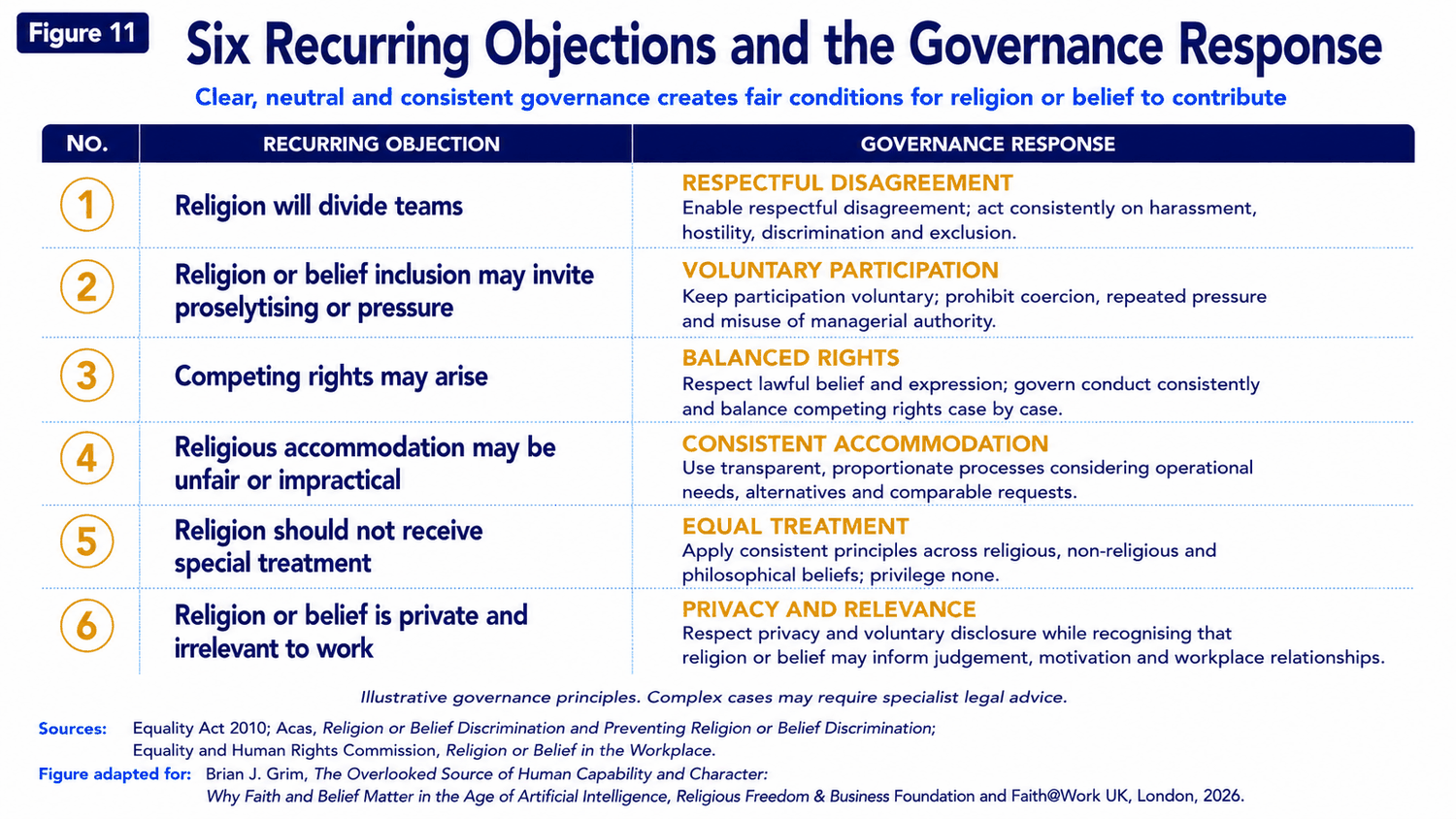
Concerns about division, proselytising, competing rights, accommodation, fairness and privacy require capable governance, not avoidance: neutrality, voluntary participation, clear boundaries and protection from coercion. The REDI Monitor and REDI Index make practice visible. Boards govern conduct, culture and organisational conditions, not employees’ beliefs.
14 and 15. Govern human capability, and begin with a conversation
Boards should govern human capability as a strategic asset. The first step is not a new programme. It is to ask the question.
Four immediate Board actions
- Recognise the competencies and qualities of character most material to strategy, culture, risk and responsible technology, and whether religion or belief is an overlooked source.
- Enable employees who wish to do so to bring religion or belief into working life appropriately and voluntarily, including employee experience and managers’ confidence.
- Value the potential contribution of perspectives shaped by religion or belief in leadership, culture, decision-making and the responsible use of technology.
- Review the baseline; how conduct, accommodation, competing rights and privacy are governed; priorities; executive ownership; and Board oversight.
Cite this paper
Take it to your Board
Download the paper, share it with a director or chair, and ask the question: are we creating the conditions in which an important source of character, judgement and human capability can contribute?
Download the white paperBoard conversation guideRead the case studiesExplore REDI