

Five case studies
Five pathways from faith or belief to organisational capability.
The cases differ in sector, geography, scale and level of implementation. Together they show an important principle: there is no single pathway through which faith or belief becomes organisationally relevant. What matters is whether insights and qualities formed in people can find consistent and repeatable expression in organisational life.
The five pathways
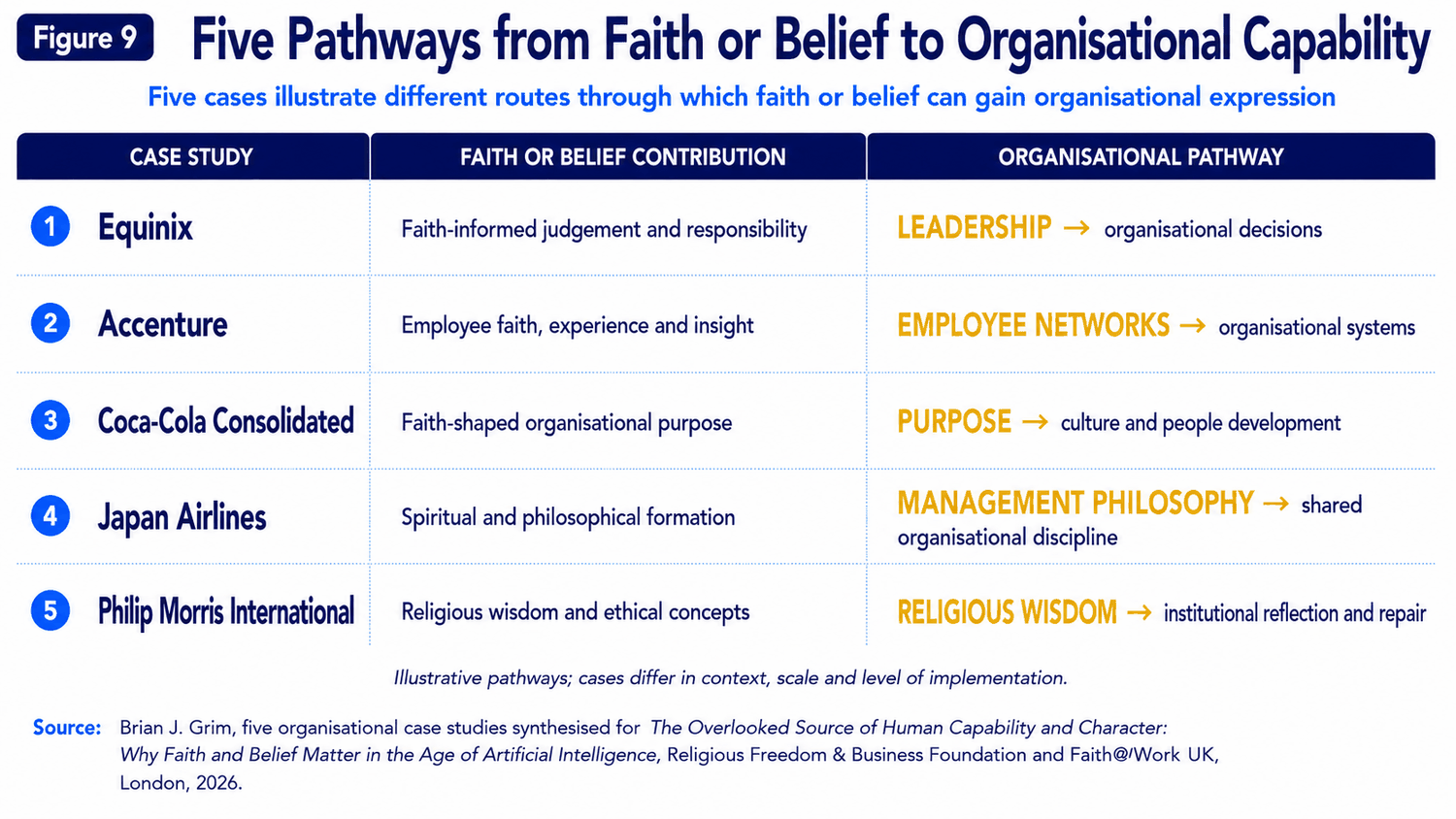
Source: Brian J. Grim, The Overlooked Source of Human Capability and Character: Why Faith and Belief Matter in the Age of Artificial Intelligence, Religious Freedom & Business Foundation and Faith@Work UK, London, 2026. Case summaries below are drawn from section 9 of the paper.
Equinix
Pathway: Leadership to organisational decisions
Faith-informed judgement and awareness of religious practice shaped leadership decisions during crisis, including employee safety, Ramadan observance, customer continuity, risk and trust.
Watch: Bruce Owen, President of Equinix EMEA: keynote at Dare to Overcome 2026
Accenture
Pathway: Employee networks to organisational systems
Employee faith networks and practical support became catalysts for wider organisational capability across leadership, culture, talent, policy, innovation and systems.
Watch: Sumreen Ahmad, Accenture: keynote at Dare to Overcome 2022
Coca-Cola Consolidated
Pathway: Purpose to culture and people development
Christian purpose has been translated into servant leadership, people development, service and the company's t-factor learning platform.
Watch: Frank Harrison, Chairman and CEO: welcome to Coca-Cola Consolidated
Japan Airlines
Pathway: Management philosophy to shared organisational discipline
Kazuo Inamori's Buddhist, spiritual and philosophical formation became a shared management philosophy, reinforced through education, leadership expectations, decision criteria and accountability.
Philip Morris International
Pathway: Religious wisdom to institutional reflection and repair
An independently commissioned study drew on Jewish, Christian and Islamic wisdom as sources of insight into institutional trust, responsibility, repair and transformation.
What the cases have in common
Character is expressed in behaviour
Judgement, integrity, responsibility, trustworthiness, courage, stewardship and care for others show up in decisions and relationships.
Translation is deliberate
Human capability becomes organisational capability when leadership, culture, management practice, learning, policies, systems and accountability reinforce it.
Governance keeps it safe
Neutrality, voluntary participation, clear boundaries and protection from coercion apply in every case.
What would the pathway be in your organisation?
Use the Board conversation guide to ask where religion or belief may already be contributing, and whether the conditions for that contribution are in place.