

[Return to Lesson 5A.]
[Return to Lesson 5B.]
Lesson 5A Business Skills Development Activity – Global Version
Activity: Unlocking Education
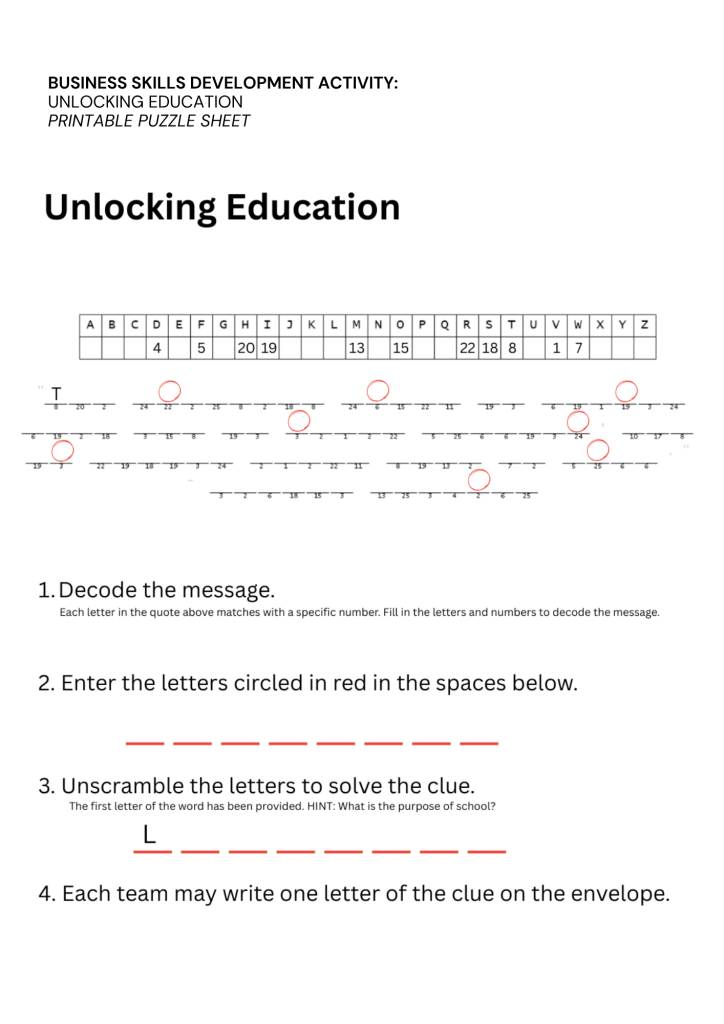
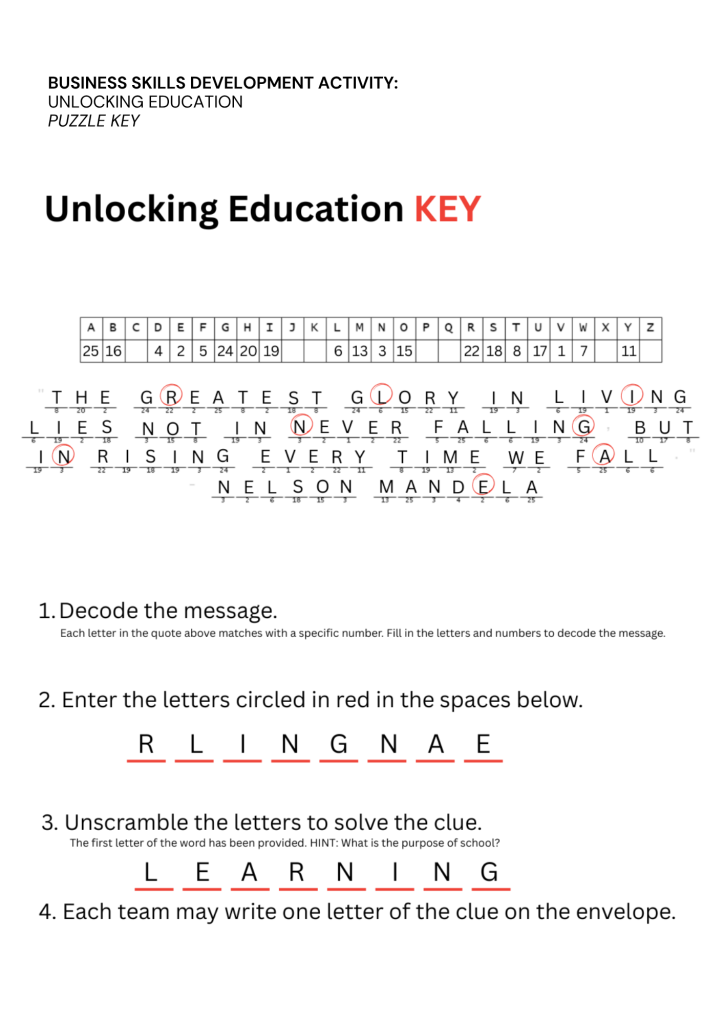
Prepare for the activity in advance by placing a small prize in an envelope, sealed, with four empty boxes drawn on the outside, to be filled by the letters “FREE” during the activity. Seal that envelope inside a larger envelope, this one with eight empty boxes drawn to be later filled by the letters “LEARNING.” Fill in the first letter (L) before class.
Possible prizes could be small stickers for each student, a ticket for a treat, a pass for extra outdoors time, a poster that congratulates students for unlocking education, or even slips of paper for each student that say “Certified Resilient Learner.”
Divide the class into seven groups and give each group a puzzle sheet (p. 53). Encourage students to read all of the instructions before beginning. As each group solves the clue, allow them to write one letter on the outside envelope. Once the word “LEARNING” is filled in, invite students to open the envelope and reveal the inner envelope. Read the riddle below for students to guess the final word, “FREE.” Once students guess the word, allow them to open the envelope and reveal the prize inside.
Riddle
“I can mean no cost, or a feeling unbound; I am what you become when chains are unwound. What am I?”
If students struggle to solve the riddle, you can give a hint by filling in the first letter.
Questions
- What emotions did you feel during the activity?
- Did you feel like giving up? Why or why not?
- What strategies did you use to keep going even when it was tricky?
- How does this relate to getting an education?
- How have you shown resilience in your education?
- In what areas of your life do you think resilience will be a helpful skill?
Lesson 5B Business Skills Development Activity – Global Version
Activity – Story: The Boy Who Harnessed the Wind
Today we’re going to learn about someone who faced big problems but didn’t give up. The business skill we’re focusing on is called resilience. Resilience means not giving up, even when things are hard. It means trying again when something doesn’t work. This is a true story about a young man who learned useful information that helped him build something extremely important to his community.
Read the story and show the picture of the windmill (see below).
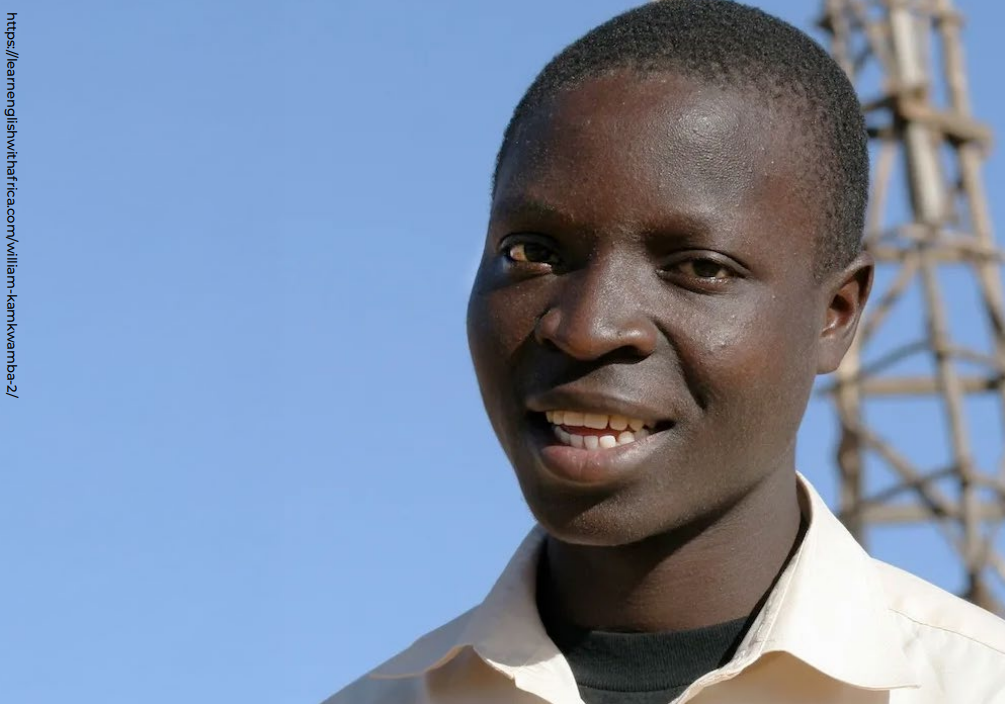
William Kamkwamba was a young schoolboy from Malawi, who had a talent for fixing radios. He spent his free time looking through the local junkyard for electronic components that he could use to make or fix things for his friends and neighbors. However, his family were farmers who struggled against poverty and poor farming conditions, and could not afford to pay his tuition fees, so he was forced to drop out of school. Fortunately, William persuaded his science teacher to let him continue attending his class and to give him access to the school’s library where he learned about electrical engineering and energy production.
But while William was learning all he could, the country began to experience a terrible drought. There was no way to bring water to the village. Plants and animals were dying, including his family’s crops. Then they were robbed of their meager grain stores, and there were riots and thieving as the people fought desperately against starvation.
Seeking to save his village from the drought, William used the information he’d been studying and the materials he had scavenged earlier, and he created a small prototype of a windmill that could power an electric water pump. However, to build a larger windmill for the village, William needed his father’s permission to dismantle the family bicycle for parts. But it was the only bicycle in the village and the family’s last major asset, so his father refused to take the risk.
It wasn’t until William’s dog died of starvation that his mother intervened and convinced his father to reconsider and allow William to use the bicycle. With the help of his friends and the few remaining members of the village, they built a full-sized wind turbine which allowed the villagers to bring water to the village, saving the people from starvation. Today William helps other villages do the same thing, making life better for everyone.
Questions
- What are some difficulties William faced getting an education? Do you think getting an education takes resilience?
- How did William show resilience? What did he do to keep learning?
- What challenges did William and his family face?
- How did the villagers feel about their challenges?
- What did William do before he built the windmill?
- How did education help William save his village?
- What would have happened if he had given up?
- Why was the windmill so important to the village?
- Can you think of a time you had to keep going, even when something was hard?
- Why might resilience be important for reaching your goals?
Lesson 5 Business Skills Development Activity – Additional Business-Focused Resources
Activity – Story: Favio Chávez and Turning Trash into Music
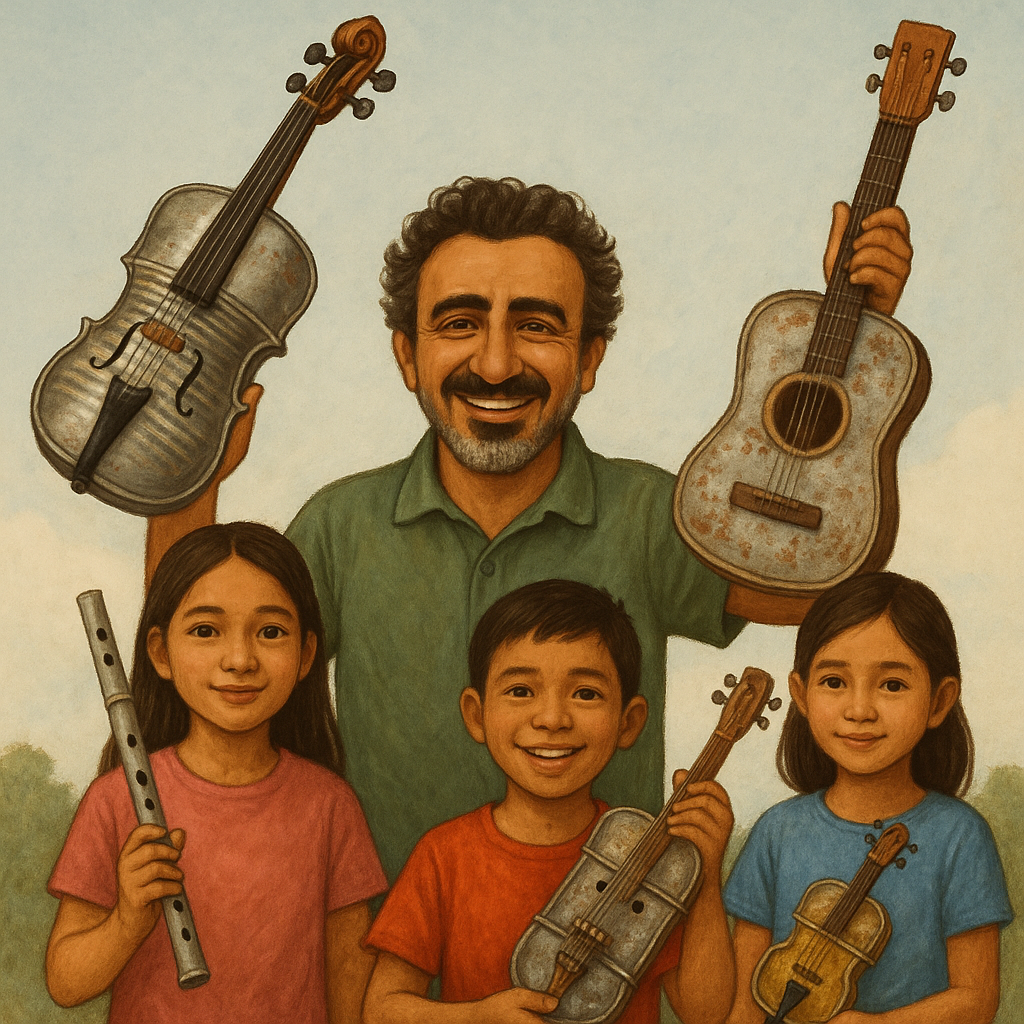
Favio Chávez was a technician at a landfill in the small town of Cateura, Paraguay, when his passion for music led him to start an orchestra that used instruments made out of trash. Every day, he oversaw the sorting of garbage, helping workers pick out recyclable materials. It was hard, dirty work, and the landfill was surrounded by one of the poorest communities in the country. Many families lived right next to the trash piles, and their children grew up with very few opportunities for education or creative activities. Most could not afford to buy school supplies—let alone something like a musical instrument.
Chávez had always loved music and believed that learning to play an instrument could change a young person’s life. Music teaches discipline, teamwork, patience, and confidence—skills that are valuable both in school and in future jobs. But in Cateura, violins, guitars, and flutes were far beyond anyone’s budget. A single violin could cost more than a family’s monthly income. Without access to instruments, music education seemed impossible.
That’s when Chávez had a creative idea. If instruments were too expensive to buy, what if they made their own? He partnered with a local carpenter, Nicolás Gómez, who worked at the landfill. Together, they began collecting discarded materials: oil drums, tin cans, forks, wood scraps, and bottle caps. With skill and imagination, Gómez shaped the trash into instruments. Oil drums became the bodies of cellos; baking tins became violin backs; forks were bent into tuning pegs. At first, the instruments looked strange, but they worked—and they made music.
Chávez started teaching music lessons after his work shifts using these recycled instruments. At first, only a handful of kids showed up, but word spread quickly. Soon, dozens of children were learning to play. Chávez and his students formed the “Recycled Orchestra of Cateura,” a group that played classical music, folk songs, and popular hits—all on instruments made from trash. The project not only gave kids a musical education, but also gave them confidence, hope, and a new way to see their future.
Over time, the orchestra gained international attention. They were invited to perform around the world, sharing their music and their message: that talent and determination matter more than expensive resources. Profits from concerts helped fund education for the children, and many went on to pursue higher studies or careers they had never imagined before.
https://www.theguardian.com/world/2013/apr/26/paraguayan-landfill-orchestra-music
Questions
- How did Favio Chávez help protect the children’s right to education, even though he wasn’t a schoolteacher?
- How did Chávez and the children show resilience to overcome their barriers to education?
- Besides learning to play an instrument, what life or workplace skills might the children have developed through the orchestra experience?
- If you faced a challenge in getting the education you want, what are some ways you could still reach your goal? What lessons from Chávez’s story could you use?
- How do you feel the skill of resilience will be important in your life?
Lesson 5 Business Skills Development Activity – Additional Business-Focused Resources
Activity: The Startup Curveball
Divide the class into small “startup teams” of 3–5 students.
Step 1 – Plan
Tell the students they are launching a new business (such as a café, an app, a clothing brand, or any product/service they choose). Each team should spend no more than a few minutes planning:
- What is your product/service?
- Who is your customer?
- How will you sell it?
Step 2 – React
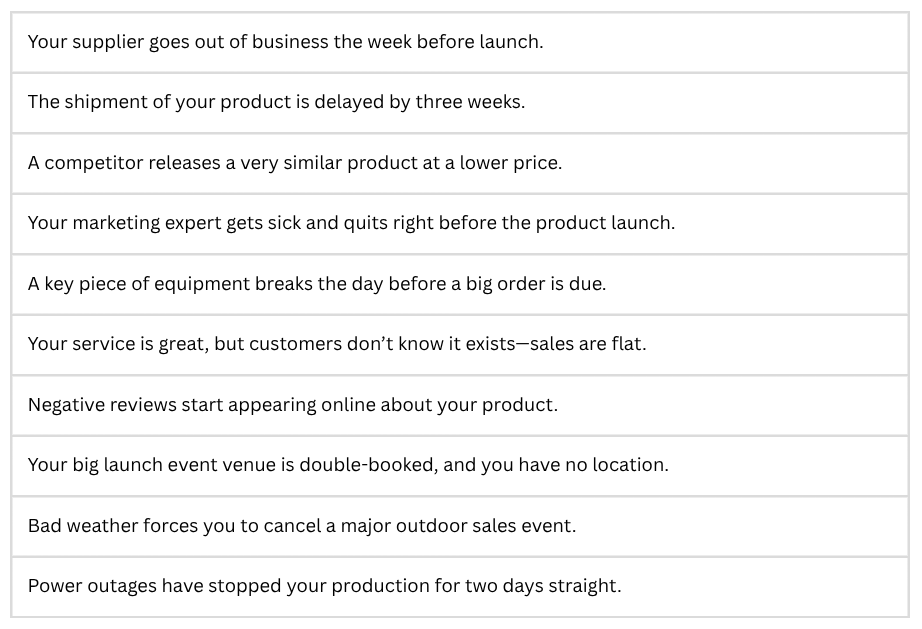
After they’ve planned, hand out “curveball cards,” prepared in advance (see examples below). Each card should describe a realistic business challenge. Teams must quickly adapt their plan to overcome the setback. They can change their product, process, or marketing, but must explain how the change will keep the business going.
Step 3 – Pitch
Each team presents:
- The original idea.
- The setback they faced.
- The change they made to adapt.
- Why their solution will still succeed.
Questions
- How do you think gaining an education will help you be resilient during future challenges?
- How did you feel when the curveball hit?
- What strategies helped you bounce back quickly?
- How did you feel after you found a solution to the curveball?
- How does this activity relate to resilience in real jobs?
Example Curveball Cards
Last updated: 06/06/26