

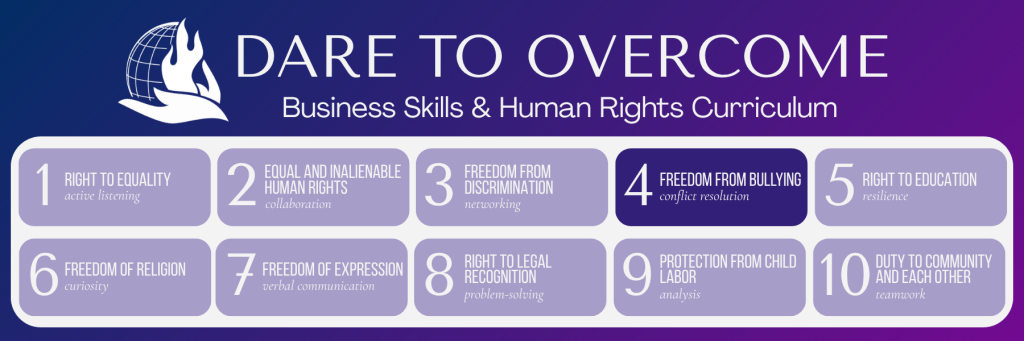
Human Right: Freedom from Inhuman Treatment
Business Skill: Conflict Resolution
QUICK START
UDHR Article(s): Article 3, Article 5
Estimated Time per Lesson: 45 minutes
For Each Lesson, You Will Select:
(1) Song
(2) Review Activity
(3) Business Skills Development Activity
(4) Activity [Only Lesson 4B]
(5) Challenge
Objectives: students will
(1) define bullying and explain why it is important to report bullying to someone they trust
(2) identify the differences between conflict and bullying
(3) practice appropriate responses to bullying
(4) practice methods for resolving conflict
Lesson 4A – Freedom from Inhuman Treatment
Article 3
Everyone has the right to life, liberty, and security of person.
Universal Declaration of Human Rights
Article 5
No one shall be subjected to torture or to cruel, inhuman or degrading treatment or punishment.
Universal Declaration of Human Rights
Business Skill: Conflict Resolution
The ability to address disagreements constructively by finding solutions that address the root causes and meet core needs through communication and understanding.
“Win/Win is a frame of mind and heart that constantly seeks mutual benefit in all human interactions.”
Stephen R. Covey (2004). “The 7 Habits of Highly Effective People: Powerful Lessons in Personal Change”, Simon and Schuster.
Learning Outcomes
- Students will explain to others the meaning of torture, cruel, inhuman or degrading treatment or punishment.
- Students can define bullying and give specific examples.
- Students will identify the difference between conflict and bullying.
- Students will discuss appropriate responses to conflict and bullying.
Lesson 4A – Freedom from Inhuman Treatment
Conflict Resolution
1. Welcome
2. Review
3. Discussion
For information on handling sensitive topics, see here.
Have a student read Article 3 and explain what it means (see above).
Questions
- What does security of person mean? (To feel secure and safe)
- How do we feel when we are attacked or threatened? (Unsafe, uncomfortable, upset)
- What behaviors could cause us to feel afraid this way?
Read or have a student read Article 5 (see above).
Questions
- What does it mean to torture? (To cause someone terrible pain)
- What is cruel treatment or punishment? (Willfully causing pain or suffering to others with no feeling or concern about it)
- What is inhuman treatment or punishment? (Treatment that causes intense physical or mental suffering)
- What is degrading treatment? (Treatment that is extremely humiliating and undignified)
Bullying is another word that could be used to describe this kind of behavior.
- What is bullying? (Bullying is the use of force, coercion, hurtful teasing or threat, to abuse, aggressively dominate or intimidate. The behavior is intentional and habitual. The bully seeks power over someone perceived as more vulnerable.)
- What are some forms of bullying that you have observed? (May include: threats, rumors, physical or verbal attacks, exclusion of a person from a group on purpose, hitting, kicking, pinching, spitting, tripping, pushing, taking things that do not belong to you, mean or rude comments or gestures, cyberbullying)
As a class, define the key differences between conflict and bullying.
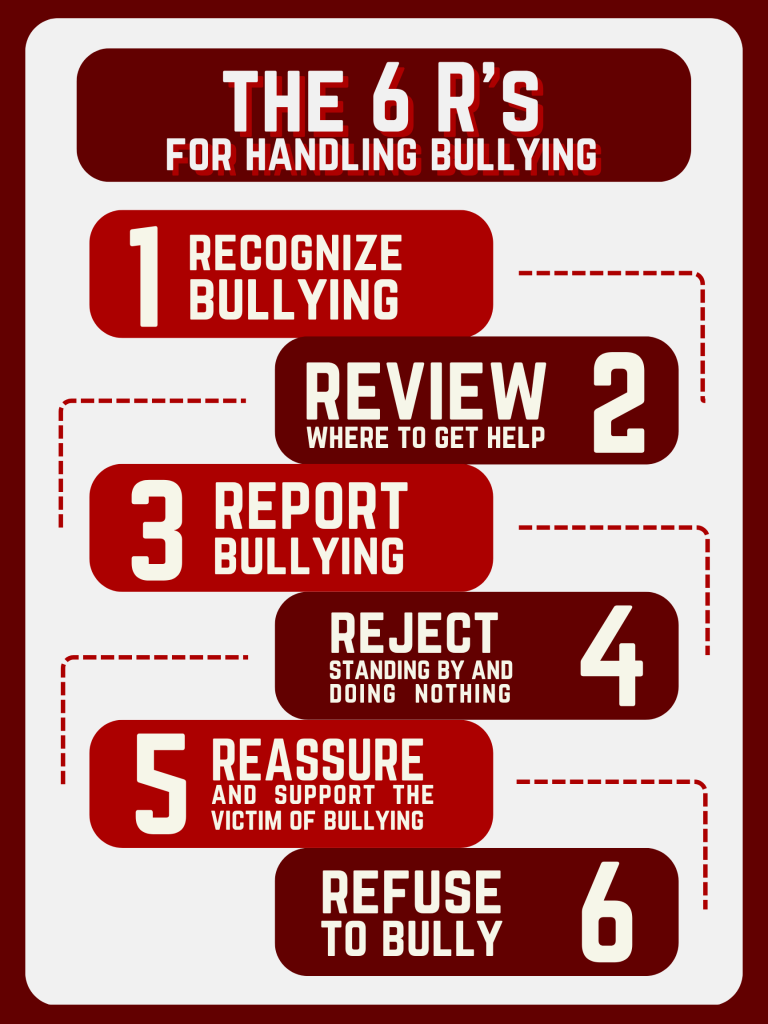
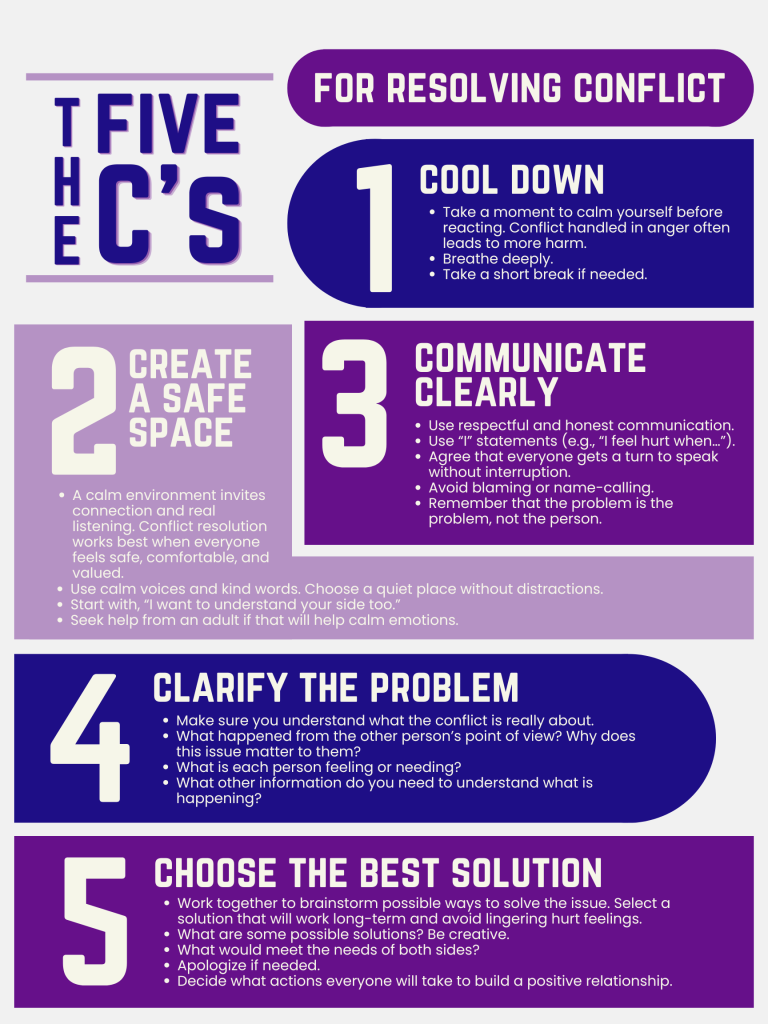
Introduce the class to the “6 R’s for Handling Bullying” Poster (see below) and “6 C’s for Resolving Conflict” Poster (see below). If possible, place them in the classroom where they can continue to be seen by students after the lesson.
4. Business Skills Development
[Select a business skills development activity.]
5. Conclusion
Discuss the following questions with the class.
Questions
- What is bullying? (Bullying is the use of force, coercion, hurtful teasing, or threat to abuse, aggressively dominate or intimidate. The behavior is intentional and habitual. The bully seeks power over someone perceived as more vulnerable.)
- Where can bullying happen? (Before, during or after school, on the playing field, in the neighborhood, on the internet, anywhere)
- Why do people bully others? (To sustain social power or status, to prove allegiance to a group, to fit in, to exclude others, to control behavior)
- Why is it important that we all enjoy life, liberty, and security of person?
6. Challenge
Lesson 4B – Freedom from Inhuman Treatment
Article 3
Everyone has the right to life, liberty, and security of person.
Universal Declaration of Human Rights
Article 5
No one shall be subjected to torture or to cruel, inhuman or degrading treatment or punishment.
Universal Declaration of Human Rights
Business Skill: Conflict Resolution
The ability to address disagreements constructively by finding solutions that address the root causes and meet core needs through communication and understanding.
“Win/Win is a frame of mind and heart that constantly seeks mutual benefit in all human interactions.”
Stephen R. Covey (2004). “The 7 Habits of Highly Effective People: Powerful Lessons in Personal Change”, Simon and Schuster.
Learning Outcomes
- Students can define bullying and explain why it is important to report bullying to someone they trust.
- Students will practice methods for dealing with bullying.
- Students will practice methods for resolving conflict.
Lesson 4B – Freedom from Inhuman Treatment
Conflict Resolution
1. Welcome
2. Review
3. Discussion
For information on handling sensitive topics, see here.
Ask a student to read Article 5 and explain what they think it means (see above).
Ask another student to read Article 3 and explain how it relates to Article 5 (see above).
Questions
- How do these articles work together to protect us from harm?
- What do we call it when someone purposely and repeatedly uses force, coercion, hurtful teasing, or threats to abuse or aggressively dominate or intimidate someone? (Bullying)
- What can you do if you see or experience bullying?
- What are some of the differences between bullying and conflict?
- What are some things you can do to handle conflict?
4. Business Skills Development
[Select a business skills development activity.]
5. Conclusion
Discuss the following questions with the class.
Questions
- What are the five steps to resolve a conflict?
- What are the six methods for dealing with a bully?
- Why isn’t it always safe to stand up to a bully?
- What can you do instead?
Read Article 5 together as a class (see above).
6. Challenge
Last updated: 06/01/26