

Lesson 4B Activity – Global Version
Activity: Conflict Compass
Label four walls or corners of the room with the following labels:
North = Talk it Out
South = Get Help
East = Walk Away
West = Compromise
Explain to the students how the four areas represent different ways to respond to conflict or bullying situations. To “Talk it Out” means to use respectful communication to resolve the issue. To “Get Help” is to find an adult or trusted person when there’s a power imbalance or you feel unsafe. To “Walk Away” means to disengage from the conflict peacefully. “Compromise” means finding a solution that works for everyone involved.
Read the first scenario and ask: “Which direction on the compass would you go?” Allow students to move to the corners of the room labeled with each compass point to show their answers. Ask a student from each area why they chose that response. Repeat with the other scenarios.
Conflict Compass – Scenarios
- Your friend is upset because you shared something they told you in confidence. You didn’t realize it was a secret.
- A student keeps sending you really mean messages online, even after you’ve asked them to stop.
- Someone is trying to start an argument with you in front of a group. You feel yourself getting really angry.
- You and your group partner disagree on how to design your presentation. You both have good ideas but are stuck.
- Your friend tells you that someone has been threatening them and they’re scared to come to school.
- You’re at lunch and someone makes a rude comment about what you are wearing. You don’t know them and they have never talked to you before.
- Your club can’t decide between two activities. Half the members want one, half want the other.
- You see a student being cornered and called names by a group in the hallway. They look really upset.
- A classmate keeps interrupting you during a discussion. You think they may not even notice they’re doing it.
- You and your friend want to hang out, but you both want to go to different places.
Lesson 4 Activity – Additional Business-Focused Resources
Activity – Story: Satya Nadella and Creating a Cultural Transformation
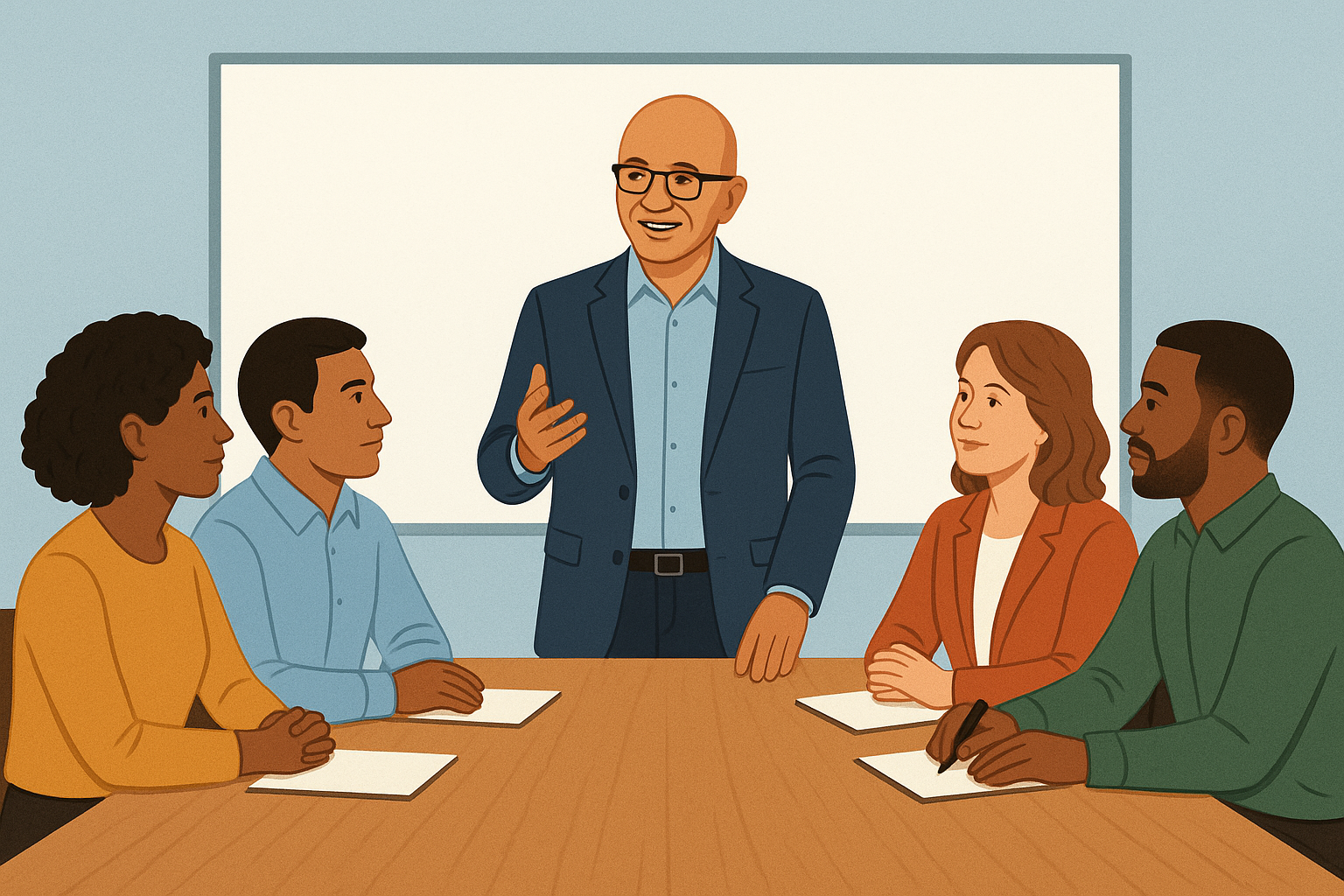
When Satya Nadella became CEO of Microsoft in 2014, the company had a reputation for being a toxic workplace. Employees were measured by an evaluation system called “stack ranking”—where they were forced to compete against each other, and managers rewarded only the top few while punishing those at the bottom. This system created bullying, backstabbing, and fear instead of teamwork. Many workers felt they were treated as disposable, not human beings with dignity.
Nadella believed this inhuman treatment was harming not only the employees but the company’s success, and decided to change it. But he knew he couldn’t simply give orders—he had to use conflict resolution skills to change the company’s culture from the inside out. First, he listened. In meetings, he encouraged employees to speak up about their challenges. He also encouraged other leaders in the company to emphasize listening, understanding, and including everyone.
One of his biggest moves was to replace the competitive review system with a growth mindset culture. Nadella taught employees to see mistakes as learning opportunities, not a sign of failure. He encouraged innovation, which often requires trying new ideas when there is a risk. These changes helped the company as a whole to develop and grow.
Nadella also emphasized empathy as an important part of success. “Ideas excite me,” he said. “Empathy grounds and centers me.” By focusing on empathy, teams were better able to cooperate on projects and solve problems together. As a result, the company became more successful financially and better able to compete with similar companies.
Slowly, bullying behaviors started to fade, and collaboration replaced conflict. Microsoft went from being seen as an aggressive giant to being admired as a company that valued humanity and teamwork. Nadella’s leadership showed how freedom from inhuman treatment in the workplace, combined with conflict resolution through listening and empathy, can transform not just a company but the lives of all of the employees connected to it.
https://www.pathos-x.com/resources/microsoft
https://press.farm/satya-nadella-leadership-style-and-philosophy/
https://www.shortform.com/blog/how-satya-nadella-changed-microsoft
https://news.microsoft.com/hitrefresh
Lesson 4 Activity – India
Activity: Compliment Circle
Ten students, five from the boys’ side and five from the girls’ side, are called forward to make two different groups. Each group is asked to make a circle. The groups are then given a random object to pass among their group members along with good compliments to whomever they pass the object to in the group. If a member is not able to give a good compliment or gives a negative compliment, he/she will be eliminated from the group. The activity goes on for two rounds and ends when a group finishes both the rounds first. At the end of the game, students are told that the objective of the activity, especially verbal bullying, can lead to ignorance from others, as it can hurt them mentally, whereas avoiding it will lead to acceptance and respect from others. The activity focuses on making the students understand verbal bullying as it’s the most common form of bullying seen in schools.
Lesson 4 Activity – India
Activity: Design and Defend: Your Vision of a Safe School
Task 1: Division
The class is divided into 5 groups and each group is given a sheet of drawing paper.
Task 2: Design
Each group has to then do a brainstorming session after which they can either draw or write on their idea of a safe and inclusive school on the material given to them.
Task 3: Hunt
After designing their safe schools , one student from each group shall try to take away the works done by the other groups repeatedly through different means without causing any fights. ( This act gives the idea of a disrespect of boundaries and personal space)
Task 4: Defend
As the students tries to take away the works of each group , Each group shall try to protect their works through means such as these: Tries to cover up the works using their hands , hide it in some notebook , keep it in their desk(Note: Every students has to think of different means to protect their work).After that the teachers shall give them a tag with articles and nep policy mentioned on it which they would attach to their works.
Task 5: Relate
The students understand that each and everyone has got the individual perspective of a safe and inclusive environment and just like the students used different means to protect them the government has given the NEP Policy as well as various articles in the constitution to protect themselves and their ideas of safety and inclusivity.
Further an explanation of, in what context the UDHR was formed and in which year? What does it means? Which of the rights in it protect us from bullying are explained.
Lesson 4 Activity – India
Activity: Story, Mahatma Gandhi and the Strength to Stand Alone
As a young man, Mohandas Karamchand Gandhi traveled to England to study law. Being far from home, in a new culture, he often felt lonely and different. Gandhi wore simple clothes, followed a vegetarian diet, and practiced his values sincerely. His quiet nature and strong moral beliefs made him stand out among his peers.
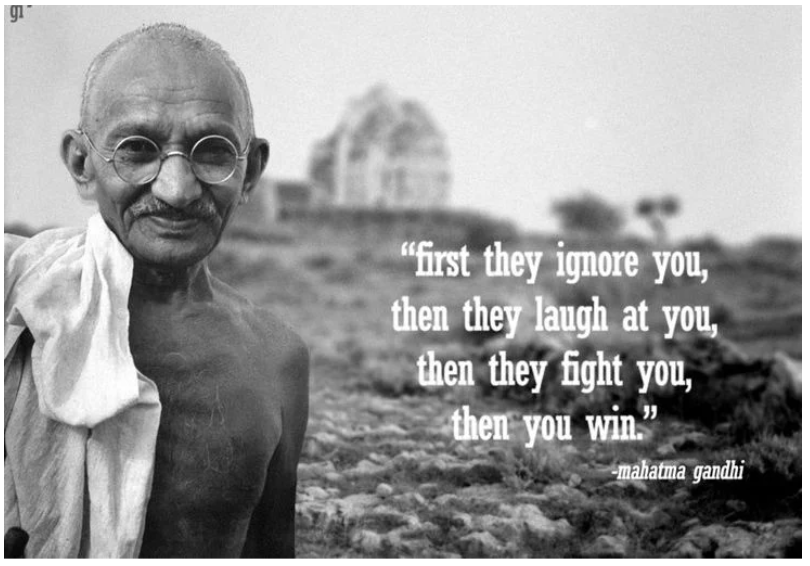
Mahatma Gandhi was a leader of India’s freedom movement who followed the path of non-violence and truth. He inspired millions with his fight for justice and independence.
At school, some classmates began to mock him. They laughed at his Indian attire, teased him for not eating meat, and questioned his silence and discipline. One student even tried to convince him that vegetarianism was foolish and outdated. Gandhi felt deeply hurt but refused to give in to peer pressure. He remained respectful and calm, choosing not to respond with anger or insults.
Instead, Gandhi visited the local library and read books about vegetarianism, religion, and moral living. He used knowledge and truth as his tools. Over time, his classmates began to see his quiet strength. Some grew curious about his choices, and a few even started respecting his dedication.
This experience of being bullied shaped Gandhi’s character. It taught him the power of self-control, the importance of staying true to one’s values, and the strength of nonviolence. He realized that one doesn’t need to fight back with anger — sometimes, the strongest response is quiet dignity.
Later in life, Gandhi would use these same principles to lead India’s freedom struggle, inspiring millions through truth and nonviolence.
Lesson 4 Activity – India, Additional Activities
Activity: Wrinkled Heart
Objective: To show how bullying hurts and how words can leave lasting effects.
Materials: A paper heart for each student
Steps:
- Give each student a heart-shaped paper.
- Ask them to crumple it every time they hear a mean statement like: “You’re not good enough.”, “No one wants to play with you.”
- Then ask them to smooth out the heart. This is followed by a discussion where the teacher asks the questions.
Q1. Does the heart look the same again?
This shows how bullying hurts on the inside, and even if we say sorry, the pain can remain. Everyone has the right to feel safe and loved—bullying takes that away
Lesson 4 Activity – India, Additional Activities
Activity: Kindness Chain
Objective: Promote positive behavior and show how kindness can replace bullying.
Materials: Strips of paper for each act of kindness, Stapler or glue to make a paper chain
Steps:
- Ask students to write kind things they have said or done recently (or will do) on paper strips.
- Link them together to create a Kindness Chain around the classroom.
- The goal is to grow it bigger than any problem caused by bullying!
- Kindness is stronger than bullying. Every small action matters
Lesson 4A Activity – Colega Primary Manual
Activity: Story, “Ogugua and the Bully”
It was Ogugua’s first day at the new school. “Please welcome our newest friend,” the teacher said.
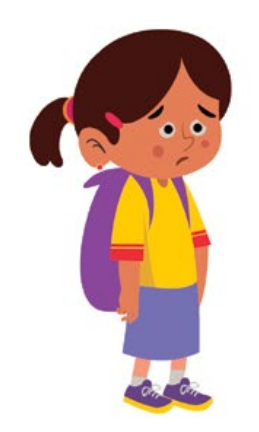
But when it was break time, the children ran outside, forgetting all about Ogugua. She sat down by herself as she watched the other kids play.
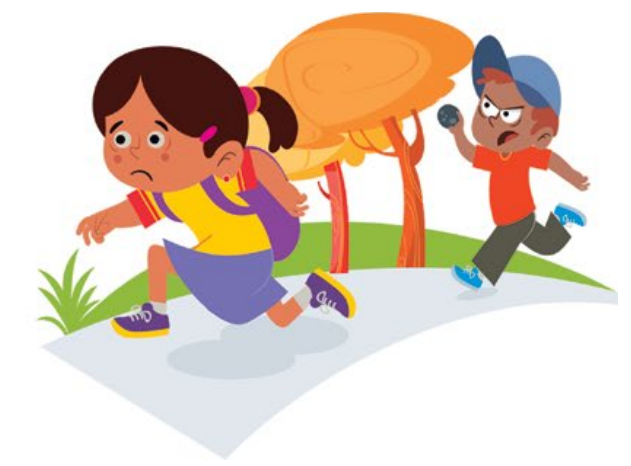
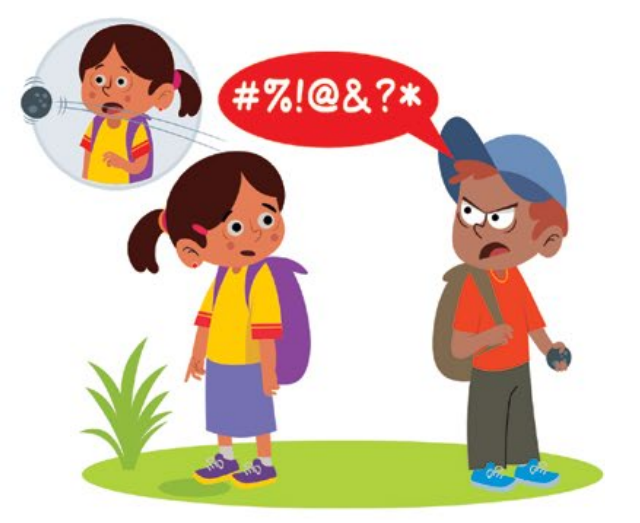
After school as Ogugua walked home alone, she heard a gruff voice yell, “Hey, you! Stupid! You sure are ugly,” just as a rock barely missed her!
She turned to see an angry, red-faced, big boy named Musa bellowing, “Get outta my way! I hate you!”
Terrified, Ogugua ran the rest of the way home, wondering what she had done. Then it happened again the next day.
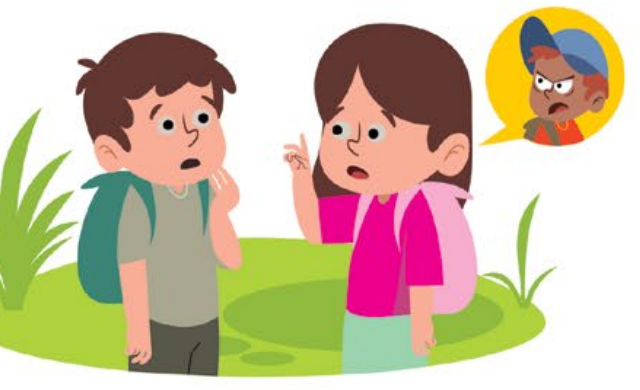
On the third day, she heard, “Hey, Stupid! Go back where you came from!” Tears ran down Ogugua’s face as she rushed home.
But this time, Kneda had seen the whole thing. It made her sad. She told her friend Jamal about it, and it made him sad, too.
“Let’s do something!” he said.
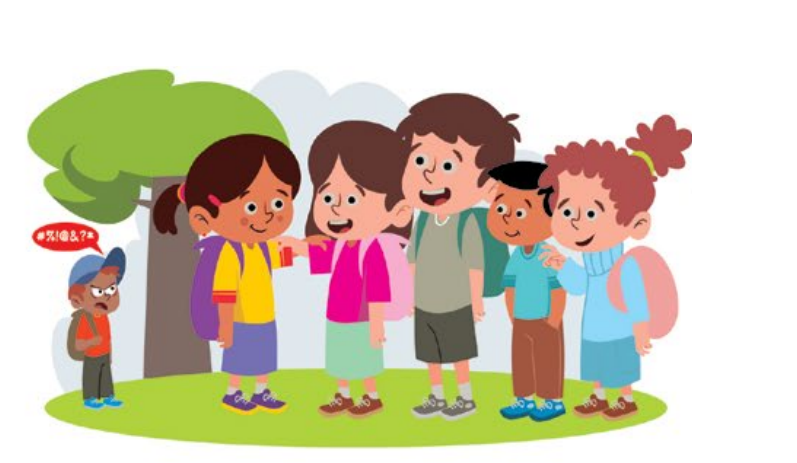
So they talked and came up with a plan. The next morning, while Kneda walked to Ogugua’s house, Jamal quickly ran ahead to tell his classmates their plan.
“We need to help Ogugua!” he said.
Soon Jamal came running back to join Kneda and Ogugua. “Everyone wants to walk with you,” he told Ogugua. By the time they got to school, they were happily walking and talking together. All except frowny-faced Musa. “I don’t want to play with you anyway,” he said loudly as he went off to be by himself.
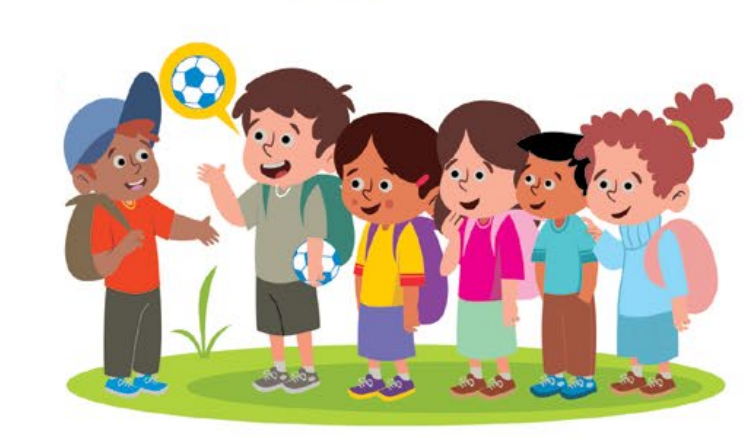
However, Jamal and Kneda had another idea. “Hey, Musa,” Jamal called out. “We need you to play on our team.” Musa couldn’t help smiling. “Sorry I was such a bully,” he said, “Let’s all be friends!”
Questions
- Who was kind in the story?
- What does kindness look like in this story?
- Who was hurtful and what did he do?
- If we don’t want bullying in our community, what can we do to stop it?
Have the students turn to their neighbor and say something to make Ogugua feel better. Discuss why one of the most important things that we must do is to make sure that we don’t bully other people.
No bullying allowed! Let’s say that together: No bullying allowed!
Lesson 4B Activity – Colega Primary Manual
Activity: Development, “Orgugua and the Bully”
In the story of “Ogugua and the Bully”, Kneda was both a Bystander and an Upstander.
Questions
- What does Bystander mean? (A Bystander is a person who stands by and watches the bullying but doesn’t do anything to stop it or to help the person being bullied.)
- What does Upstander mean? (An Upstander is someone who knows that what is happening is wrong, and he or she stands up to the bully and tells him or her to stop it or figures out a way to stop it.)
- When was Kenda an Upstander and when was she a Bystander?
- Who else was an Upstander?
- Why is it better and more courageous to be an Upstander?
- Discuss how you could be an Upstander.

Lesson 4B Activity – Colega Primary Manual
Activity: Puzzle Time, Article 5
Before class, cut up the puzzle pieces, and put them in an envelope or container.
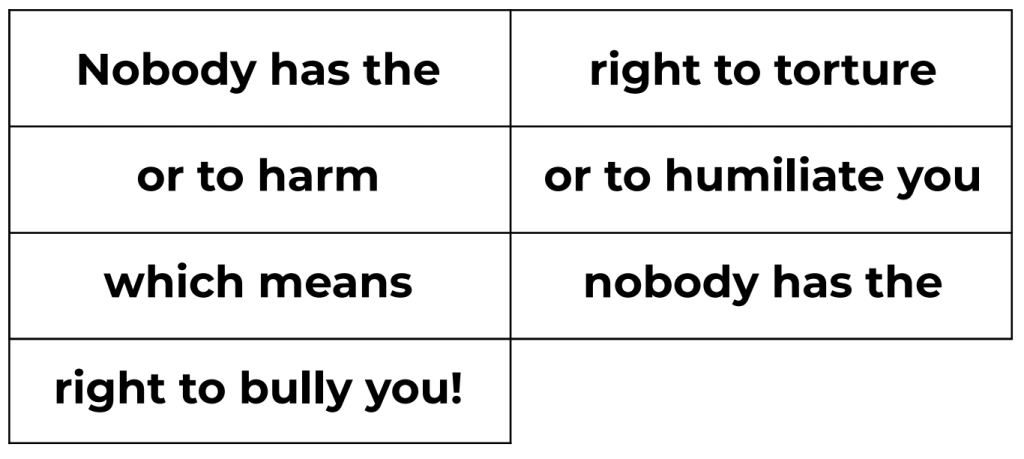
Instructions:
- Ask seven volunteers to come up and stand by you.
- Hand each student one of the pieces of paper from the puzzle. Make sure they’re out of order.
- Ask the students to arrange themselves in the proper order as quickly as they can.
- Tell the rest of the class to see if they can remember the order, so that they can help if needed.
- When they finish, everyone claps their hands. Read the puzzle together again. Nobody has the right to torture or to harm or to humiliate you, which means nobody has the right to bully you.
Ask: No one has the right to do what? (Bully you!)
Lesson 4B Activity – Colega Primary Manual
Activity: Paper Mash-Up
Have a student pass out paper and pencils to everyone.
- Ask students to write the words Bullying Is… at the top of their paper. Students take one minute to draw a simple picture or words about what bullying looks like to them. Bullying is something that somebody does on purpose to make you feel bad or hurts you, and the person does it many times. For example: Making fun of your clothes, or hitting or pushing, teasing or calling names, taking things without permission, saying things about you behind your back, not letting you play, or sending mean notes, emails or text messages, etc.
- When finished, have students pair up. Give them two minutes to discuss their pictures and words and how they would stop the bullying.
- Ask students to look at their own picture and follow these instructions:
- Crumple up your paper into a ball. Be careful not to rip it.
- Unfold your picture and smooth it out as flat as possible.
- Look at how scarred it is even though it is flat.
- Raise your hand if you were able to bring your paper back to its original look and feel.
- This is what it’s like when one person bullies another person, we can’t undo it.
Questions
- What can we do when someone is afraid because she or he is being bullied?
- How can we help each other feel safe?
- How would our school and family be different if we all did more kind things?
- Why is it hard to take back unkind looks, words, actions or behaviors?
- What can you do if you have bullied someone and you are sorry? (Apologies, acts of kindness and other positive efforts.)
It is hard to fix the hurt, but it can be done.
Lesson 4B Activity – Colega Secondary Manual
Activity: What Do I Do?
Teacher Note: Change student names and examples as necessary to match your culture.
Tell the stories and ask students what they would do to help stop the bullying.
Story 1
Ella and her family moved to a new neighborhood. She had lots of friends, both boys and girls. Unfortunately, two girls in her neighborhood were jealous of Ella. They began spreading rumors and lies about her on the internet, saying that her behavior was not good. Soon other girls in the neighborhood thought Ella was not good and their parents didn’t want them to be friends with her.
What could you do to be an Upstander in this situation?
Story 2
Heather was very tall for her age and she had an illness that affected her appearance. She was often the object of ridicule, teasing, and taunting. Heather didn’t feel like she had value, even though she was very smart and good at school.
What could you do to be an Upstander in this situation?
Story 3
John began losing hearing when he was seven years old. At first, he loved his hearing aids because he could finally hear what others were saying. When he got into secondary school, he had to remove the hearing aids and put them in his locker when he played soccer or climbed ropes in the gym. One day he came back from soccer and found the hearing aids
were missing. Some of the boys laughed and pointed to another row of lockers. When John turned the corner, he saw his hearing aids on the ground, smashed.
What could you do to be an Upstander in this situation?
Story 4
Nikola liked playing basketball with his friends after school. One day Stefan came to the court and started calling Nikola and his friends ugly names. Stefan walked up to Nikola and took his ball. Nicola told Stefan and his friends that they could play, but the basketball was his. Stefan began shoving Nikola so hard he fell to the ground. His friends started calling Nikola names and laughing at him as they passed the ball around above him.
What could you do to be an Upstander? Is it safe?
Story 5
Simon is worried about going to school. Everyone knew he was different from others. He wore different clothes, and ate different food. He was slowly learning the language, but he sounded different. One day he was surrounded by a group of boys just beyond school. The boys hit, kicked, and spit on Simon. They called him rude names and told him to go back where he came from. A group of students gathered around to watch.
What could you do to be an Upstander? Is it safe?
Story 6
Mara saw what was going on. Girls were whispering, passing notes, and laughing. She knew she was the target of their fun because they had done the same thing online. She didn’t even look at her phone anymore. Now the same thing was happening at school. She wanted to be invisible.
What could you do to be an Upstander?
Last updated: 05/20/26