

Building on Dare to Overcome London 2026, towards the UK’s G20 year.
By Brian J. Grim, Ph.D., Global Chair, Dare to Overcome
Following the US midterm elections, there will be plenty of discussion about what political leaders should do next. But there is another question worth asking, whatever our politics and wherever we live:
What can we do together to make the world a better, kinder place?
We do not need to agree on everything to answer that question. People with different religious, philosophical and political convictions can work together to expand opportunity, protect human dignity and help their neighbours flourish.
That does not mean setting aside deeply held beliefs or overlooking injustice. It means recognising that disagreement need not prevent cooperation, and that defending our own freedom should include respecting the freedom of others.
This is the common way forward that Dare to Overcome seeks to advance: not uniformity of belief, but shared responsibility expressed through practical action.
From a remarkable week to a year of shared work
At Dare to Overcome London 2026, business leaders, investors, policymakers, academics and faith communities came together to explore The Economics of Kindness. Across the week, conversations connected responsible leadership, inclusive workplaces, economic opportunity and the human implications of artificial intelligence.
For us, the Economics of Kindness is a practical challenge. What does respect for human dignity change about the way we employ people, invest resources, educate young people and use technology? How do we make our values visible in decisions that affect others?
The next stage is to build on the relationships formed in London and connect promising initiatives with people who can help them develop.
London 2027 should be where we share progress, not where we wait to begin.
Working with the Religious Freedom & Business Foundation, Faith@Work UK and our wider network of partners, we want to advance six connected areas of work.
1. Equip young people with rights, skills and opportunities
A common future requires young people who can work across differences, understand their responsibilities and recognise both their own dignity and that of others.
Our Human Rights & Business Skills Curriculum connects human rights education with practical skills for working with others. Its lessons have been piloted in schools in India with educators from MIT World Peace University, providing experience on which further adaptations can build.
We are exploring ways to pilot the curriculum in the UK in advance of the 2027 G20 summit.
The next step is to identify interested educators, community partners and businesses, consider how the materials would fit local needs, and agree how a pilot’s usefulness could be assessed. This is an opportunity under exploration, not an announced school programme.
The ambition goes beyond teaching young people to tolerate difference. We want to help them develop the confidence and skills to cooperate, solve problems and contribute to their communities.
Educators could help adapt and test the lessons. Businesses could support their development or connect learning with the world of work. Community organisations could help ensure that young people from different backgrounds have a voice in shaping the approach.
2. Make faith and belief inclusion part of everyday working life
The workplace offers a practical setting in which people can learn to cooperate across differences.
Through the Faith-Friendly Workplace REDI Index, organisations can assess their policies and practices and identify opportunities to improve. Salesforce and MSD provide examples of the workplace leadership recognised through RFBF’s 2026 awards.
Our priority is to make those lessons useful to more employers: how employee networks build understanding, how managers respond to questions of faith and belief, and how organisations turn commitments to dignity into everyday practice.
Faith and belief inclusion must respect everyone, including people with no religious affiliation. Participation should be voluntary, with clear boundaries, privacy and protection from coercion. It is not about asking an employer to endorse a religion.
Between now and 2027, we want more organisations to examine their starting point, choose practical improvements and share what they learn. An employer does not need to begin with a large programme. A thoughtful conversation, a review of practice or participation in REDI can provide a starting point.
3. Strengthen human judgement in the age of AI
As technology expands what organisations can do, the question of what they should do becomes more consequential.
Our Board Paper, Why Faith and Belief Matter in the Age of Artificial Intelligence, identifies seven qualities on which organisations depend: wise judgement, integrity, responsibility, trustworthiness, courage, stewardship and care for others. It asks leaders to recognise how these qualities are formed through families, communities, education, experience and traditions of religion or belief.
We want to take that discussion into boardrooms, leadership development and everyday decisions about technology and people.
A useful first step is a focused leadership conversation: What human qualities does our organisation depend on? How are we cultivating them? Who remains accountable when AI informs a consequential decision?
The Faith & AI discussion at BNP Paribas and Dell’s interfaith exploration of faith in the age of AI offer further resources for this work. Religious Freedom & Business Foundation
We are also exploring an expanded AI, Faith & Human Dignity gathering in 2027. Its value should come from helping people make better decisions throughout the year, not simply generating another discussion about technology.
4. Connect ethical investment with practical opportunity
Values become economically significant when they influence where resources go, whose ideas receive support and what opportunities become possible.
The pilot Multi-Faith Economy Index, launched at Lambeth Palace in October, was developed by Consulus with the Religious Freedom & Business Foundation and the FoRB Foundation. It examines public evidence of how faith-aligned institutions connect their beliefs with investment, governance and other decisions. It provides a starting point for greater transparency and learning, rather than a guarantee of impact.
Building on this work, we want to explore collaboration among Islamic finance, other faith-informed financial traditions, ethical investors, philanthropists and entrepreneurs.
The practical question is not simply how much capital these communities hold. It is how their resources and experience might help worthwhile enterprises create jobs, widen opportunity and serve communities.
We are exploring a larger faith-based impact investment gathering in 2027. In the meantime, we welcome introductions to investors and enterprises interested in exchanging experience, identifying shared priorities and developing credible partnerships.
5. Share stories that lead to action
Recognition matters most when it helps others see what is possible.
The King Husein Global Business & Interfaith Peace Awards highlight leaders who build understanding across communities through business, investment, education and culture. The 2026 awardees offer examples of different routes towards that shared purpose. dto.world
The London Human Dignity Film Forum brought another dimension to the 2026 programme, using film and discussion to explore courage, opportunity and human dignity. We hope to build on that foundation through an expanded festival in 2027.
Our aim is to connect inspiration with practical learning. What made an initiative work? What obstacles did its leaders encounter? What would another community need to adapt it successfully?
We welcome stories that can answer those questions, including modest local initiatives as well as internationally recognised achievements. A useful example need not be large. It needs to offer something others can learn from and put into practice.
6. Bring practical experience into the G20 conversation
The UK’s 2027 G20 presidency creates an opportunity to connect this work with international discussions about economic opportunity and human flourishing. The government has confirmed that the G20 Leaders’ Summit will take place in Manchester on 27–28 November 2027.
We are exploring opportunities to share lessons through the G20 Interfaith Forum and other networks that connect faith-informed experience with public policy. IF20’s work brings religious, academic, civil society and policy perspectives into dialogue around global challenges.
DTO is independently organised, not an official G20 event. Our contribution should be grounded in practical experience: what educators learn from a pilot, what employers discover about inclusion, what investors can demonstrate about impact, and what communities achieve through cooperation.
The goal is not to present every initiative as a universal solution. It is to offer credible examples, acknowledge limitations and help others judge what might be useful in their own settings.
What should be different by the time we meet again?
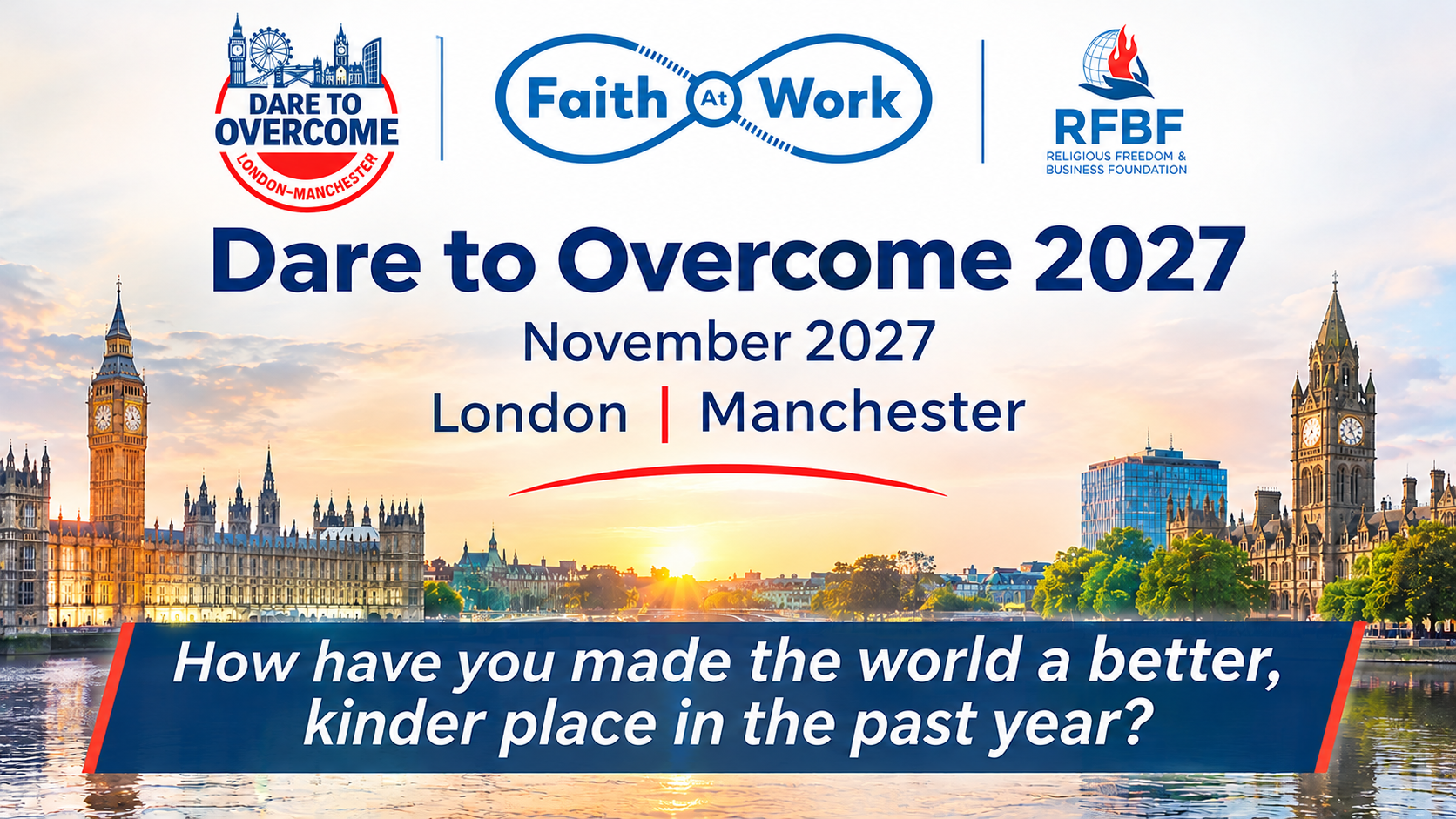
We are planning to gather again in London in November 2027, with dates and programme details still to be confirmed.
By then, we want more to share than a list of meetings.
We want to hear about young people gaining useful skills, employers improving practice, leaders making more responsible decisions and partnerships opening opportunities that did not previously exist.
Some efforts will be pilots. Others will expand established work. Some will reveal approaches that need to change. Honest learning should be part of the contribution.
For each initiative, we can begin with a manageable goal, identify who needs to be involved and decide what evidence would show progress. That gives our shared ambition a practical form.
The measure of the movement should be what people accomplish together between gatherings.
Help shape the common way forward
You do not need to wait until London 2027 to take part.
Bring an initiative. Tell us about work that advances human dignity, economic opportunity or cooperation across differences, and what would help it develop.
Contribute your expertise or resources. Help explore a school pilot, strengthen workplace practice, convene a leadership discussion, support a promising project or share a story others can learn from.
Open a door. Introduce an educator, employer, investor, community leader or creative partner whose involvement could make a difference.
To begin, email me with the subject “DTO 2027: My contribution”. A few sentences are enough: what you would like to advance, what you can contribute and what help or connections you need.
When we gather again, our shared question will be:
How have you made the world a better, kinder place in the past year?
We do not need to think alike to begin answering it together.