
Empowerment+ Manchester: Interfaith Leadership in Action
Building religious freedom through leadership, life skills and service to others
Manchester, United Kingdom | 2016–2017
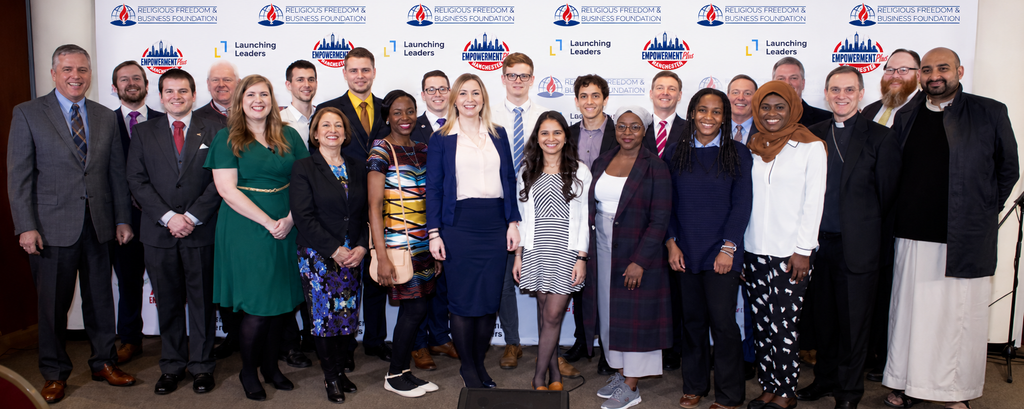
In January 2017, Sir Alex Ferguson, legendary former manager of Manchester United, presented certificates to a group of young adults from Catholic, Muslim and Latter-day Saint communities at Manchester Universities’ Catholic Chaplaincy.
The occasion marked the graduation of the first interfaith Launching Leaders pilot, part of the Religious Freedom & Business Foundation’s (RFBF) Empowerment+ initiative.
But this was more than a graduation ceremony. It was a celebration of what happens when people of different faiths learn together, develop practical skills for life and work, and put their beliefs into action by serving others.
Sir Alex spoke to the graduates about leadership, drawing on his experience managing one of the world’s most successful football clubs. He emphasised the importance of listening, giving encouragement and recognising the contributions of others.
As he reminded the graduates, “It is so important to say ‘well done’.”
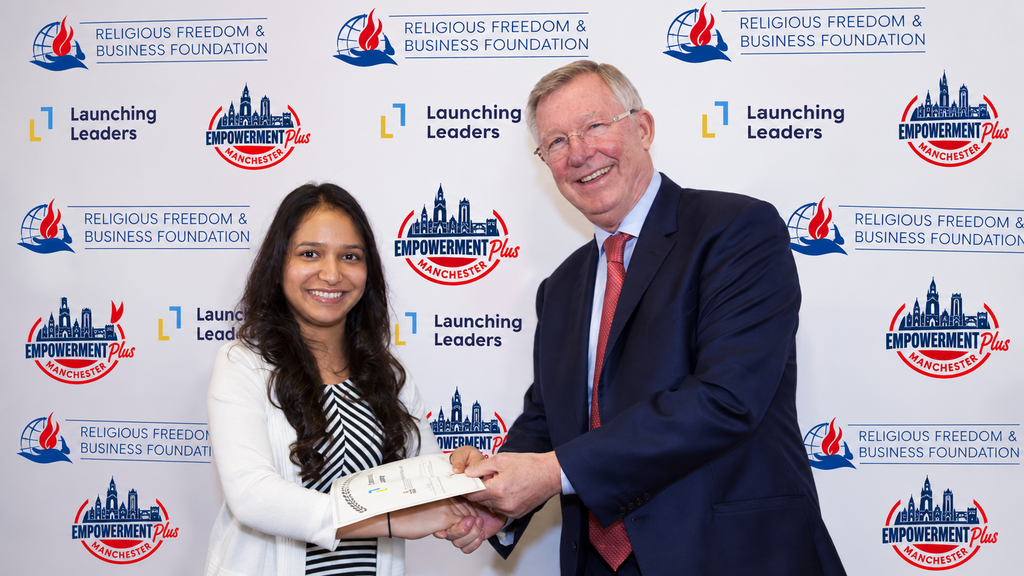
Sir Alex Ferguson presents certificate to Hinna Parvez Maluch, a religious Freedom & Business Foundation Research Fellow who played a central role in bringing the programme to life.
Sir Peter Fahy, former Chief Constable of Greater Manchester Police, was instrumental in connecting RFBF with the Catholic Chaplaincy and Muslim community leaders.
The initiative also received encouragement and support from Bishop John Arnold of the Catholic Diocese of Salford, Mohammed Ullah, honorary Muslim chaplain at Manchester University, and other religious and community leaders.
Empowerment+ coordinated with various community organisations to find mentors and opportunities for engagement and service.
A Manchester Partnership Across Faiths
The Manchester pilot was coordinated internationally by Dr Brian J. Grim, President of the Religious Freedom & Business Foundation, and locally by Hinna Parvez Maluch, an RFBF Research Fellow who played a central role in bringing the programme to life.
It was hosted at Manchester Universities’ Catholic Chaplaincy, in collaboration with the al-Furqan Islamic Centre, The Church of Jesus Christ of Latter-day Saints, Launching Leaders and other faith and community partners.
The projects reflected one of Empowerment+’s central principles: people become empowered not only by receiving help, but also by helping others.
From Religious Freedom to Interfaith Action
Empowerment+ was developed around a simple idea: religious freedom is not only the freedom to believe and worship, but also the freedom to put one’s beliefs into action for the good of others.
The programme brought young adults from different religious backgrounds together to explore how spiritual principles could help them find purpose, develop leadership and career skills, and contribute to their communities.
Rather than asking participants to set aside their religious differences, Empowerment+ encouraged them to draw on the teachings of their own traditions while learning from others.
One inspiration was the parable of the Good Samaritan. A man from a different religious and cultural community stopped to help a stranger in need, demonstrating that love of neighbour extends beyond the boundaries of one’s own faith or community.
Empowerment+ sought to make that principle practical. Participants supported one another in developing skills for meaningful employment and personal development, while working together on projects that benefited others in their communities.
The result was a model of interfaith cooperation based not simply on dialogue, but on shared learning, mutual responsibility and service.
Learning Together, Serving Together
The Manchester pilot took place at Manchester Universities’ Catholic Chaplaincy, bringing together Catholic, Muslim and Latter-day Saint participants and mentors for weekly sessions combining personal development, leadership and spirituality.
Participants explored questions that remain relevant throughout life: What gives my life meaning? How can I develop my potential? How should I manage my time and finances? What does it mean to lead with integrity? How can my faith help me contribute to the lives of others?
Importantly, the learning extended beyond the classroom.
In one memorable project, participants went out into the Manchester rain to collect litter outside a mosque in Newton Heath. The activity was a gesture of friendship and solidarity with local Muslims and part of a wider series of community service projects.
It was a small action with a larger purpose: demonstrating that people from different religious traditions could work together to make their communities more welcoming.
As Manchester coordinator Hinna Parvez Maluch observed:
We have more in common than anything that may divide us.
Three Interconnected Elements of Empowerment+
Empowerment+ brought together three complementary resources, linking spiritual development, practical life skills and service.
1. Launching Leaders: Finding Purpose and Developing Leadership
Developed in partnership with Launching Leaders, this programme helped young adults explore their potential and develop a personal foundation for meaningful living.
Through mentoring, videos, interactive exercises and group discussions, participants addressed leadership, goal-setting, financial self-reliance, communication, personal responsibility and the relationship between spirituality and everyday life.
The interfaith adaptation encouraged participants to reflect on these subjects through their own religious traditions while learning alongside people of other faiths.
2. Find a Better Job: Practical Skills for Economic Opportunity
The second element focused on the practical challenges of finding meaningful employment and achieving greater economic self-reliance.
Find a Better Job provided a structured, group-based approach to strengthening employment skills, confidence and mutual support.
An interfaith version of the resource was piloted in Manchester, with further workshops following the initial Launching Leaders programme.
The materials were adapted with permission from The Church of Jesus Christ of Latter-day Saints, whose international self-reliance programme provided the foundation for the resource.
3. Interfaith My Foundation: Putting Spiritual Principles into Practice
Interfaith My Foundation connected the leadership and employment resources with practical spiritual principles.
Drawing on teachings from Christian, Muslim, Jewish, Hindu, Buddhist and other traditions, it addressed subjects including integrity, responsibility, managing money, using time wisely, communication, learning, perseverance and service to others.
The aim was not to minimise differences between religions, but to demonstrate how people could draw on their respective beliefs to address common challenges and help one another succeed.
Why Empowerment+ Matters
The Manchester experience demonstrated a practical approach to building religious freedom and social cohesion.
Participants did not need to agree on theology to learn together, form friendships, develop useful skills or serve their neighbours. Indeed, their different religious backgrounds were part of what made the experience valuable.
The initiative connected three things that are often treated separately: personal and spiritual development, economic opportunity, and cooperation across religious differences.
It also illustrated a broader principle of RFBF’s work: religious freedom becomes especially meaningful when people can use that freedom to contribute positively to the communities in which they live.
Manchester provided an early example of how religious communities, universities, volunteers and local leaders could work together to make that possible.
The lasting lesson of Empowerment+ is that bringing people of different faiths together to learn, work and serve can help build stronger individuals, stronger relationships and stronger communities.
More Testimonies