Freedom of Religion or Belief (FoRB) Education in action: Examples from around the world
Education is regularly cited in FoRB spaces as being an under-developed but essential tool in the promotion and protection of FoRB in societies around the world. Having set out in an earlier paper in this series a conceptual framing for Education for FoRB, this paper presents a series of vignettes – Culham St Gabriel’s (England), Dare to Overcome (India), Hardwired Global (Iraq), and the Leimena Institute (Indonesia) – of organisations who have developed approaches to promoting and protecting FoRB through Education.
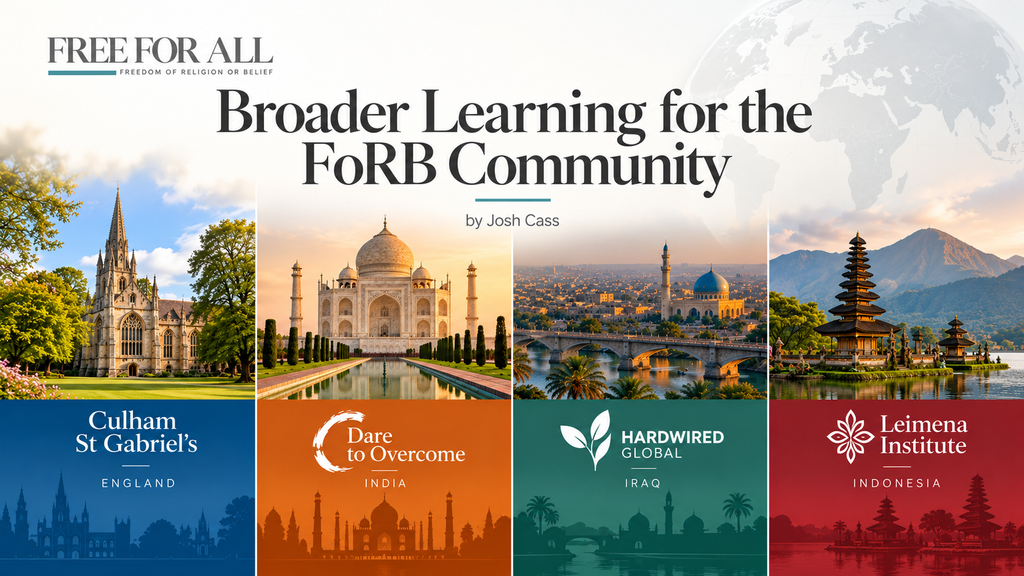
The organisations in this paper were identified through desk-based research. All four deliver their work in formal educational settings (schools) and have developed a methodology which is consistently applied. The author of this paper invited key personnel from each project to complete a short questionnaire (see appendix 1); the responses were then used to develop each vignette. As such, each vignette reflects the organisation’s own account of its work.
It is beyond the scope of this paper to evaluate the effectiveness of each organisation. As noted earlier in this series, FoRB Education is an under-developed concept, far better therefore to encourage mutual collaboration and learning than to set projects against one another. Nonetheless, it is possible to draw some conclusions, or at least, to gain a sense of what works by placing these four vignettes alongside each other.
Presented in alphabetical order, each example follows the same structure: a brief presentation of background and aims, their alignment with FoRB Education Principles, and, design choices made to encourage take up and engagement.
A more detailed explanation of FoRB Education Principles can be found in the first paper of this series. However, for reference, the key features of FoRB Education are that it should enable children to:
- talk about their own religion or belief, experience ways in which other people explore and express meaning, and, to learn about where and how their religion or belief may be different to others;
- talk about freedom, what it means to be free, what it means for others to be free, and what it might mean or feel like to have those freedoms restricted specifically in relation to FoRB;
- learn about Human Rights, that they are for everyone everywhere and that FoRB is a human right.
Having presented the four vignettes, the paper then presents some wider reflections for the FoRB Community. A paper such as this is better placed to stimulate thought than to provide solutions, nonetheless, taken together with the earlier paper and the soon to be published resource directory a path ahead for FoRB Education starts to take shape.
The author would like to express thanks to the following individuals who gave their time and expertise; their contributions were essential to the development of the vignettes, without them this paper would not have been written:
Dr Brian Grim (Religious Freedom & Business Foundation and Dare to Overcome), Dr Matius Ho (Leimena Institute), Tina Ramirez (Hardwired Global) and Dr Kathryn Wright (Culham St Gabriel’s Trust)
Additional Resources
Questionnaire for Case Studies