

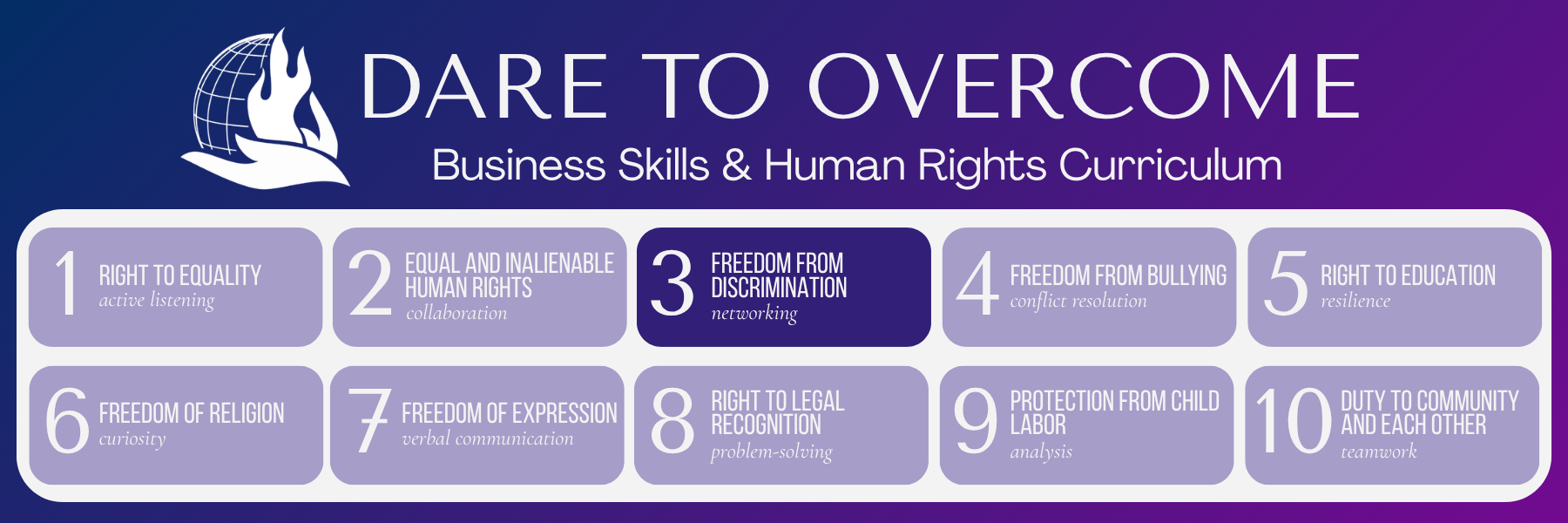
Human Right: Freedom from Discrimination
Business Skill: Networking
QUICK START
UDHR Article(s): Article 2
CRC Article(s): Article 23
Estimated Time per Lesson: 45 minutes
For Each Lesson, You Will Select:
(1) Song
(2) Review Activity
(3) Business Skills Development Activity
(4) Activity
(5) Challenge
Objectives: students will
(1) be able to explain that everyone is entitled to all the same rights and freedoms without distinction or difference
(2) identify examples of discrimination and explain why discrimination against anyone is a violation of human rights
(3) demonstrate familiarity with basic components of the business skill of networking
Lesson 3A – Freedom from Discrimination
Article 2
Everyone is entitled to all the rights and freedoms set forth in this Declaration, without distinction of any kind, such as race, color, sex, language, religion, political or other opinion, national or social origin, property, birth or other status.
Universal Declaration of Human Rights
Business Skill: Networking
The process of building and maintaining relationships to exchange information, support, and opportunities for mutual benefit.
“Trust is the glue of life. It’s the most essential ingredient in effective communication. It’s the foundational principle that holds all relationships.”
Stephen R. Covey, A. Roger Merrill, Rebecca R. Merrill (1995). “First Things First”, Simon and Schuster.
Learning Outcomes
- Students can explain that everyone is entitled to all the same rights and freedoms without distinction or difference.
- Students can discuss why discrimination against anyone is a violation of human rights.
- Students will give examples of how women and men are equally well-suited for most tasks.
- Students will understand the concept of networking and be able to practice it in informal settings.
Teacher Note: These lessons focus mainly on two kinds of discrimination, gender and disability. However, Article 2 includes many others. Feel free to focus on any types of discrimination you feel need to be discussed in your area.
Lesson 3A – Freedom from Discrimination
Networking
1. Welcome
2. Review
3. Discussion
For information on handling sensitive topics, see here.
Read or have a student read Article 2 from the Universal Declaration of Human Rights (see above).
Explain that Article 2 talks about Discrimination.
Question
- What is discrimination? (Discrimination is treating one another unequally or without dignity or respect, or denying rights to another)
Read Article 2 together (see above).
Questions
- Tell about a time when someone you know was treated differently from others. In what ways?
- What does without distinction mean? (It means no matter what. No matter what our race or language, sex, religion, etc., we have all the human rights that everyone else has.)
4. Business Skills Development
[Select a business skills development activity.]
5. Conclusion
6. Challenge
Lesson 3B – Freedom from Discrimination
Article 2
Everyone is entitled to all the rights and freedoms set forth in this Declaration, without distinction of any kind, such as race, color, sex, language, religion, political or other opinion, national or social origin, property, birth or other status.
Universal Declaration of Human Rights
Article 23
If you have any kind of disability, you should have special care, support and education so that you can lead a full and independent life and participate in the community to the best of your ability.
Convention on the Rights of the Child
Business Skill: Networking
The process of building and maintaining relationships to exchange information, support, and opportunities for mutual benefit.
“Trust is the glue of life. It’s the most essential ingredient in effective communication. It’s the foundational principle that holds all relationships.”
Stephen R. Covey, A. Roger Merrill, Rebecca R. Merrill (1995). “First Things First”, Simon and Schuster.
Learning Outcomes
- Students can identify examples of discrimination.
- Students can explain why discrimination against anyone is a violation of human rights.
- Students can describe what is necessary for those with disabilities to lead a full and independent life and participate in the community.
- Students will demonstrate familiarity with basic components of the business skill networking.
Teacher Note: The rights of the child are specific rights documented in the Convention on the Rights of the Child (CRC). They are a tool to protect all children everywhere from violence and abuse. This treaty was adopted by the United Nations on November 20, 1989. As of April 2017, the Convention on the Rights of the Child is the most ratified document of the United Nations. More information is included in the Facilitator’s Guide.
Lesson 3B – Freedom from Discrimination
Networking
1. Welcome
2. Review
3. Discussion
For information on handling sensitive topics, see here.
Read or have a student read Article 23 of the CRC (see above).
Questions
- How do persons with disabilities experience discrimination? Share examples.
- What does the word disability mean? (A disability is any condition of the body or mind (impairment) that makes it more difficult for the person with the condition to do certain activities (activity limitation) and interact with the world around them (participation restrictions).)
- What is meant by special care, support, and education?
- How can someone with a disability have a full and independent life and participate in the community?
4. Business Skills Development
[Select a business skills development activity.]
5. Conclusion
Discuss the following questions with the class. Note: Adapt the questions below to fit the activity selected in section 3.
Questions
- What good things would come from being friends with someone with a disability?
- What kinds of things can leave someone with a disability? (Birth defects, medical conditions, accidents, war, etc.)
- What helped Matt Scott overcome the challenges of Spina Bifida?
- What kind of discrimination did Matt experience?
- How did he overcome it?
- What qualities did Matt need to succeed with his goal to play basketball?
- How can we help those with disabilities achieve their objectives?
- How is collaboration an important skill when working with people with different abilities?
6. Challenge
Last updated: 05/26/26