

Human Right: Equal and Inalienable Human Rights
Business Skill: Collaboration
QUICK START
UDHR Article(s): Preamble, 3
Estimated Time per Lesson: 45 minutes
For Each Lesson, You Will Select:
(1) Song
(2) Review Activity
(3) Business Skills Development Activity
(4) Activity [Only Lesson 2A]
(5) Challenge
Objectives: students will
(1) recognize and exercise the rights agreed to by the United Nations (UN) and explain how everyone benefits when human rights are upheld
(2) understand the importance of the business skill of collaboration
(3) practice collaboration in showing respect for the rights of others
Lesson 2A – Equal and Inalienable Human Rights
Preamble: Right to Equality
- 1. “Whereas recognition of the inherent dignity and of the equal and inalienable rights of all members of the human family is the foundation of freedom, justice and peace in the world…
5. “…Whereas the peoples of the United Nations have in the Charter reaffirmed their faith in fundamental human rights, in the dignity and worth of the human person and in the equal rights of men and women and have determined to promote social progress and better standards of life in larger freedom…
8. “…The General Assembly, proclaims this Universal Declaration of Human Rights as a common standard of achievement for all peoples and all nations…”
Universal Declaration of Human Rights, – Preamble, Paragraphs 1, 5 and 8.
Business Skill: Collaboration
The ability to work effectively with others by sharing ideas, responsibilities, and feedback to achieve a common goal.
“The essence of synergy is to value differences — to respect them, to build on strengths, to compensate for weaknesses.”
Stephen R. Covey (2004). “The 7 Habits of Highly Effective People: Powerful Lessons in Personal Change”, Simon and Schuster.
Learning Outcomes
- Students will recognize and exercise the rights agreed to by the United Nations (UN) and show respect for the rights of others.
- Students will explain how everyone benefits when human rights are upheld.
- Students will understand the importance of and practice the business skill of collaboration.
Lesson 2A – Equal and Inalienable Human Rights
Collaboration
1. Welcome
2. Review
3. Discussion
For information on handling sensitive topics, see here.
In 1945 at the end of World War II, the UN appointed a committee of men and women from different countries and cultures, to create a set of principles for the whole world, known as the Universal Declaration of Human Rights. It lists 30 articles or principles that all of us should follow to ensure the life, freedom, and security of every person. These rights and the responsibility to honor the rights of others help us live together in harmony.
As we play a game, think about how it relates to the objectives of the Universal Declaration of Human Rights.
4. Business Skills Development
[Select a business skills development activity.]
5. Conclusion
6. Challenge
Lesson 2B – Equal and Inalienable Human Rights
Preamble: Right to Equality
- 1. “Whereas recognition of the inherent dignity and of the equal and inalienable rights of all members of the human family is the foundation of freedom, justice and peace in the world…
5. “…Whereas the peoples of the United Nations have in the Charter reaffirmed their faith in fundamental human rights, in the dignity and worth of the human person and in the equal rights of men and women and have determined to promote social progress and better standards of life in larger freedom…
8. “…The General Assembly, proclaims this Universal Declaration of Human Rights as a common standard of achievement for all peoples and all nations…”
Universal Declaration of Human Rights, – Preamble, Paragraphs 1, 5 and 8.
Article 3
- “Everyone has the right to life, liberty and security of person.”
Universal Declaration of Human Rights
Learning Outcomes
- Students will review the rights agreed to by the United Nations (UN).
- Students will demonstrate the meaning of the words inherent, equal, and inalienable.
- Students will explain how everyone benefits when human rights are upheld.
- Students will demonstrate understanding of strategies involved in the business skill of collaboration.
Business Skill: Collaboration
The ability to work effectively with others by sharing ideas, responsibilities, and feedback to achieve a common goal.
“The essence of synergy is to value differences — to respect them, to build on strengths, to compensate for weaknesses.”
Stephen R. Covey (2004). “The 7 Habits of Highly Effective People: Powerful Lessons in Personal Change”, Simon and Schuster.
Lesson 2B – Equal and Inalienable Human Rights
Collaboration
1. Welcome
2. Review
3. Discussion
For information on handling sensitive topics, see here.
Read the Preamble to the Universal Declaration of Human Rights and Article 3 (see above).
Questions
- Why do you think the United Nations Commission wrote the Universal Declaration of Human Rights?
- What is a preamble? (An introductory statement designed to help us know the reasons for and the intent of a document)
Listen for the words: inherent, dignity, equal, and inalienable. They all apply to rights.
Questions
- What does the word inherent mean? (An inborn, permanent, essential, or characteristic attribute)
- What does dignity mean? (A state or quality of being worthy of honor or respect)
- If we all have inherent dignity, what does that mean?
- When did we receive that dignity? (When we were born)
- Why did we receive it? (Because we are a member of the human family)
- Which of the human rights are inherent? (All of them)
- What does the word equal mean? (The same in value; a person or thing considered to be the same as another in status or quality)
- Must people be the same to be equal? (No. Men and women are equal in value, but they are not the same)
- How are they equal? (They have the same rights)
- What does the word inalienable mean? (Unable to be taken away or transferred from the possessor. It is indestructible.)
- Can your rights be taken away by someone? (If we have rights just because we are human, our rights can be violated but they cannot be taken from us. They are part of us.)
Read paragraph 1 of the Preamble again.
- What foundation do the words inherent, equal, and inalienable build? (Freedom, justice, peace in the world)
- How do these three words build a foundation?
Have a student read paragraph 5 of the Preamble.
- The UDHR confirms faith in three things. What are they? (Fundamental human rights, the dignity and worth of the human person, and the equal rights of men and women)
- What will equal rights for men and women achieve in the world? (Social progress, better standards of life and larger freedom)
Have a student read paragraph 8 of the Preamble.
What will honoring human rights achieve? (A common standard of achievement for all peoples and all nations)
4. Business Skills Development
[Select a business skills development activity.]
5. Conclusion
Show the Life, Liberty, and Security of Person Mini Poster (below).
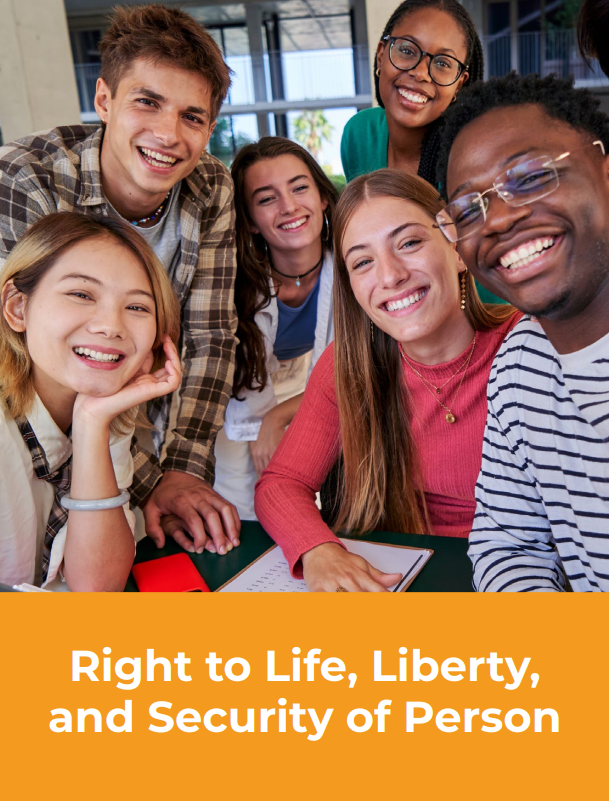
Read or have a student read Article 3 of the UDHR (see above).
Questions
- Can we have one without the others? Why or why not?
- What three rights did you hear in Article 3? (Life, Liberty, and Security of Person)
- How could you define these words in your life today?
- Which one do you think is the most important? Why?
6. Challenge
Last updated: 05/26/26