Freedom of religion or belief (FoRB) is built in practice, not simply protected in principle. It begins with education that equips young people to understand difference and respect conscience, grows through relationships that can withstand conflict and disagreement, and is strengthened by networks that turn shared commitment into collective action. If it is to be sustainable, it also must reach into economic life, where education, employment and business give people opportunities to participate fully in society without leaving their faith or beliefs at the door. In this sense, FoRB is not only a legal freedom. It is part of the social infrastructure that allows people of different religions and beliefs to live, learn, work and flourish together.
Education creates opportunity. But its promise is fulfilled when opportunity leads to dignified work.
At BYU–Pathway Worldwide, Elder Matt Eyring pioneered social impact employment, creating a practical bridge between education and the global economy.
Its certificate-first model gives students job-ready skills early, while employers around the world provide pathways into meaningful careers. Remote work allows many graduates to remain in their home countries while participating in the global economy and strengthening their communities.
For connecting education with employment and building a scalable bridge from poverty to purpose, Matt Eyring is the 2026 Education to Work Bridge Award recipient of the King Husein Global Business & Interfaith Peace Award.
On Monday, 12 October, Eyring will join Brian Ashton, President of BYU–Pathway Worldwide, for the keynote conversation, From Faith to Education to Employment: A Global Model. Together, they will explore how faith, education and employment can connect to create opportunity at scale, particularly for people whose geography or circumstances might otherwise limit access to higher education and meaningful work.
Eyring and Ashton’s keynote will bring together many of the themes explored throughout the day at the BYU London Centre, where leaders working across freedom of religion or belief, education, interfaith relations and business will examine how these fields connect in practice.
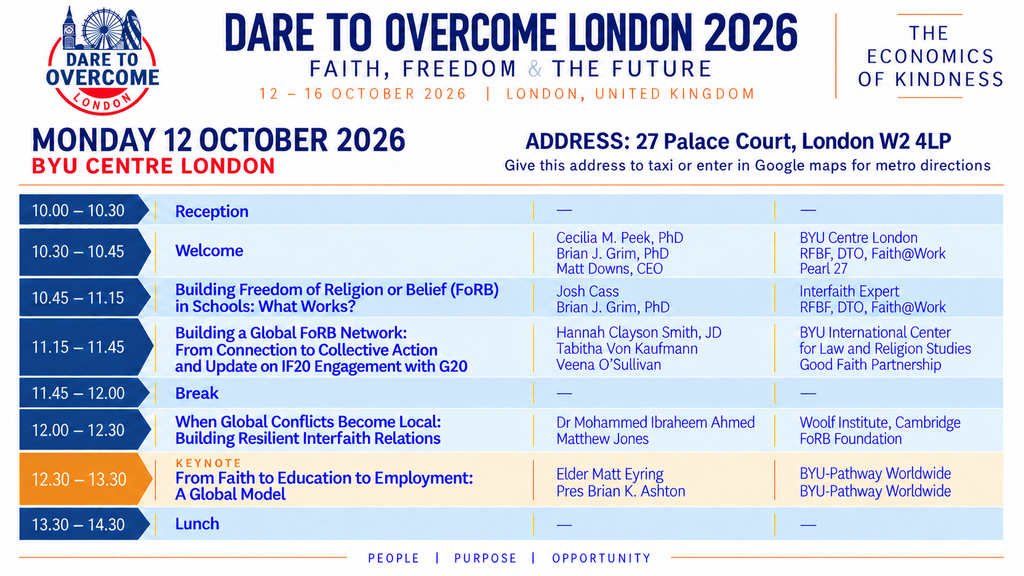
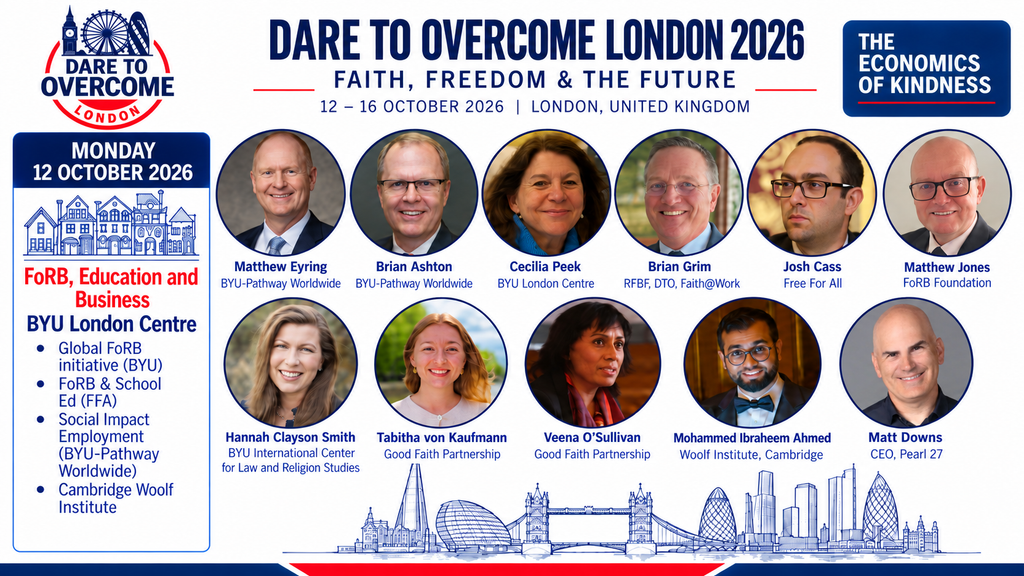
Cecilia Peek of the BYU London Centre, Brian Grim of the Religious Freedom & Business Foundation, Dare to Overcome and Faith@Work, and Matt Downs, CEO of Pearl 27, will open the programme and frame the day around a central idea: freedom of religion or belief is not only a question of rights. It also affects how people learn, participate, build relationships and contribute to society and the economy. In the Age of AI, this human dimension becomes even more important. As technology expands what organisations are capable of doing, the character guiding how that capability is used becomes more consequential. Matt Downs will draw on the new White Paper to explore the human qualities organisations increasingly depend upon, including judgement, integrity, responsibility, trustworthiness, courage, stewardship and care for others, and the often-overlooked role that faith and belief can play in forming them. The discussion will consider what this means for leaders seeking not simply greater technological capability, but the human capability and character needed to use it wisely and responsibly.
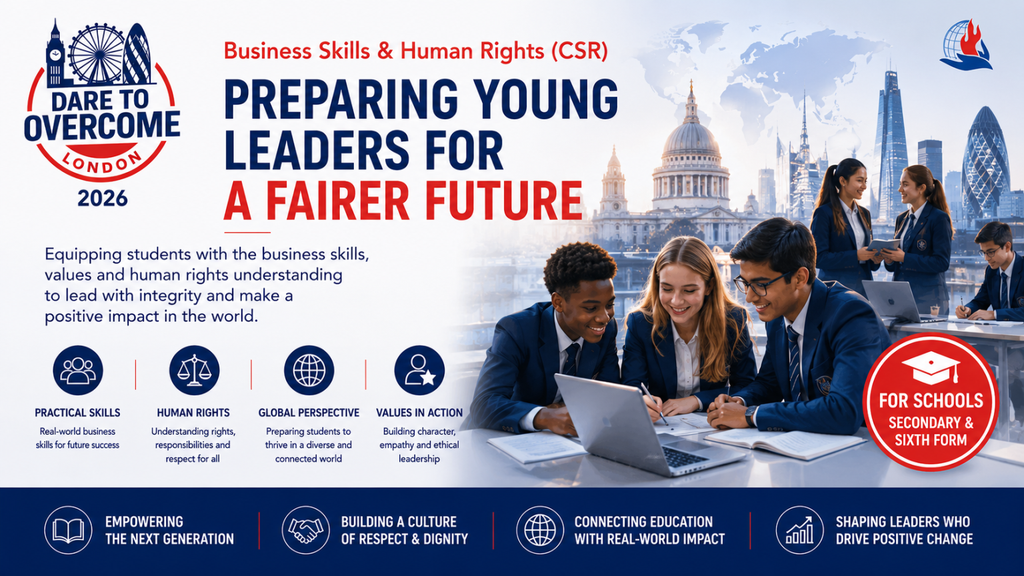
That question begins early, with Josh Cass and Brian Grim examining Building Freedom of Religion or Belief in Schools: What Works? Schools are among the first places where young people encounter difference in a sustained way. The session will look at how education can help young people understand religion or belief, navigate differences constructively and build the habits that make plural societies more resilient. One of the case studies will be Dare to Overcome’s Human Rights, Business Skills & Peace programme, which combines human rights education with practical business skills and has been piloted in schools in Pune, India, including lessons on freedom of religion, protection from child labour, marriage and family, and freedom from bullying.
The conversation then moves from local education to global cooperation. Hannah Clayson Smith, from the BYU International Center for Law and Religion Studies, will lead a discussion on Building a Global FoRB Network: From Connection to Collective Action. The focus is not simply on bringing advocates and organisations together, but on how relationships can become practical cooperation across countries and sectors.
Joining this conversation will be Tabitha von Kaufmann and Veena O’Sullivan of Good Faith Partnership, who will provide an update on IF20 engagement with the G20. With the United Kingdom preparing to host the G20 in 2027, the discussion will look ahead to opportunities for religion or belief, human dignity and constructive interfaith engagement to contribute to wider conversations about economic and social development.
The morning will also confront a challenge increasingly felt in communities around the world: what happens when international conflicts become local? Mohammed Ibraheem Ahmed of the Woolf Institute, Cambridge, and Matthew Jones of the FoRB Foundation will lead When Global Conflicts Become Local: Building Resilient Interfaith Relations. Their conversation will focus on strengthening relationships capable of withstanding international tensions, polarisation and disagreement without allowing them to fracture communities at home. Matthew will comment on how these tensions and the response to them impact international FoRB.
Together, these sessions form a deliberately connected conversation. Freedom of religion or belief creates space. Education develops capability. Interfaith relationships build trust. Employment turns opportunity into participation and dignity.
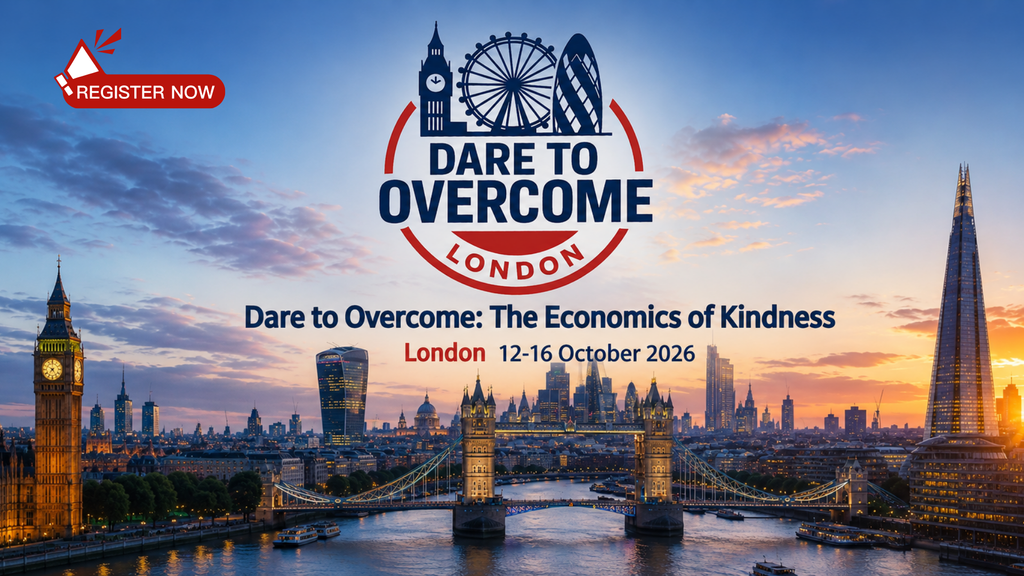
That is the journey at the heart of Monday’s programme, and it provides a fitting opening to Dare to Overcome London 2026: Faith, Freedom & the Future.
Monday, 12 October 2026
BYU London Centre
27 Palace Court, London W2 4LP
10.00 a.m. – 2.30 p.m.