

Human Right: Freedom of Religion and Belief
Business Skill: Curiosity
QUICK START
UDHR Article(s): Article 18
CRC Article(s): Article 14
Estimated Time per Lesson: 45 minutes
For Each Lesson, You Will Select:
(1) Song
(2) Review Activity
(3) Business Skills Development Activity
(4) Activity [Only Lesson 6B]
(5) Challenge
Objectives: students will
(1) identify their rights related to freedom of thought, conscience and religion and discuss why they are important
(2) describe how they can exercise their rights in connection with worship and respect the rights of others to do the same
(3) practice curiosity as a means to problem-solving
Lesson 6A – Freedom of Religion and Belief
Article 18
Everyone has the right to freedom of thought, conscience, and religion; this right includes freedom to change his religion or belief, and freedom, either alone or in community with others and in public or private, to manifest his religion or belief in teaching, practice, worship, and observance.
Universal Declaration of Human Rights
Business Skill: Curiosity
The willingness to ask questions, seek understanding, and explore new ideas to foster learning, innovation, and stronger connections with others.
“Admission of ignorance is often the first step in our education.”
Stephen R. Covey (2004). “The 7 Habits of Highly Effective People: Powerful Lessons in Personal Change”, Simon and Schuster.
Learning Outcomes
- Students will discuss why Freedom of Religion is important.
- Students will identify the various rights related to elements of practice of thought, conscience and religion.
- Students will be familiar with basic principles for interacting collaboratively with others with different beliefs.
- Students will practice curiosity as a business skill and understand its importance.
Lesson 6A – Freedom of Religion and Belief
Curiosity
1. Welcome
2. Review
3. Discussion
For information on handling sensitive topics, see here.
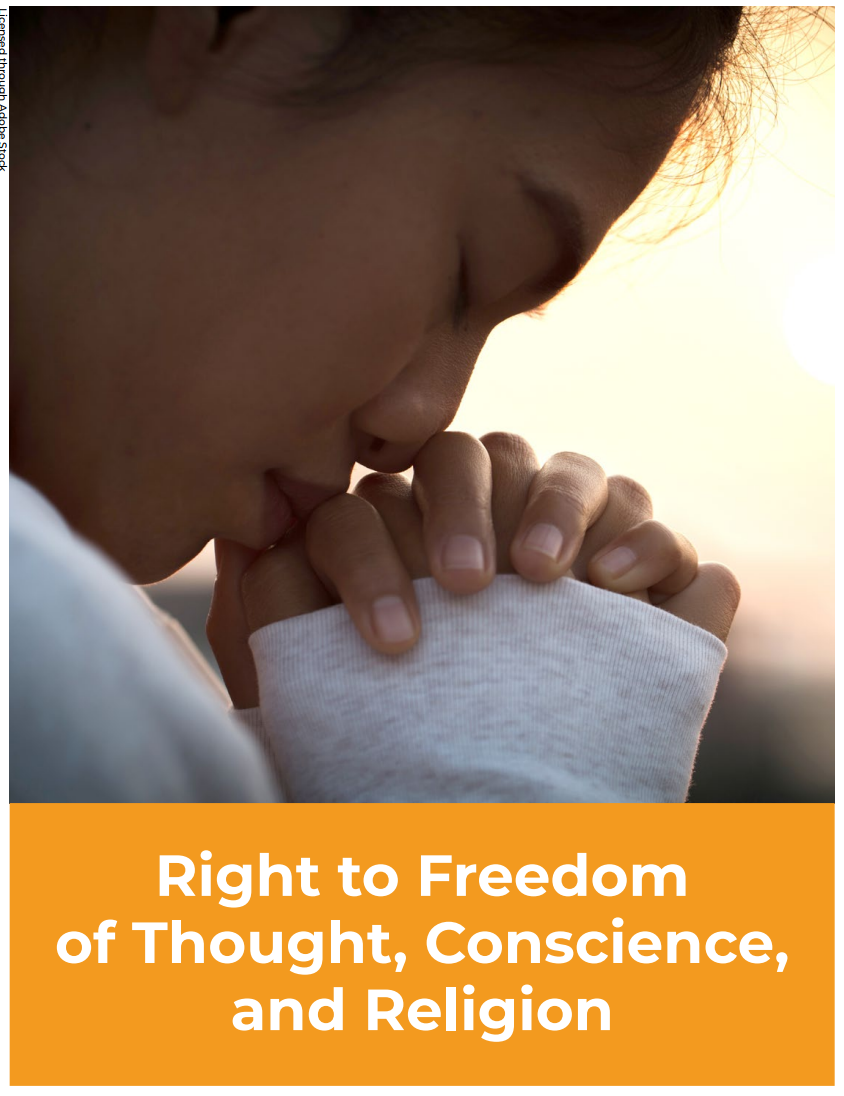
Read UDHR, Article 18 (see above), and show the Right to Freedom of Thought, Conscience, and Religion mini poster (see below).
Questions
- What are thoughts? (Ideas and opinions)
- What is conscience? (Inner feelings telling you what is right or wrong in thoughts and behavior)
- What is religion? (A set of spiritual beliefs and practices)
- What are beliefs? (Trust, faith, or confidence in someone or something)
- Why was it important to include an article about freedom of thought, conscience, and religion in the Universal Declaration of Human Rights?
- What conflicts have you observed related to freedom of thought, conscience, and religion in families and your community?
- How could respecting others’ beliefs help resolve these conflicts?
- Why is it important to be able to exercise this right alone or in community with others, in public or private?
- Why is it necessary to be able to manifest our religion or belief in teaching, practice, worship, and observance?
- Does everyone have access to this freedom? What if someone’s religion or belief is different from those around them?
Show the Key Principles of Cross-Cultural Religious Literacy poster (see below).
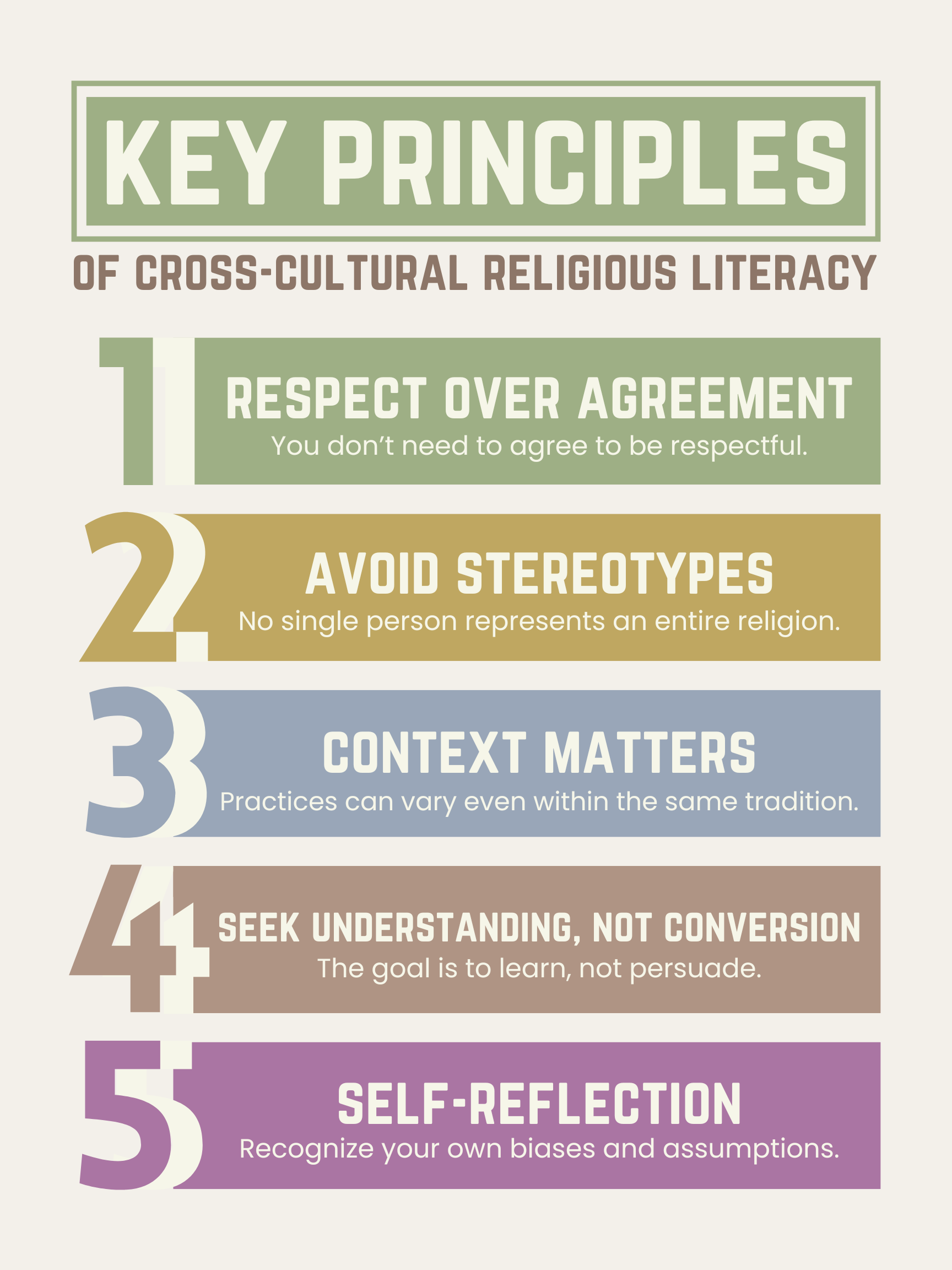
Ask the class if anyone has had an experience talking to someone who belongs to a different faith. Explain that it can sometimes feel hard to interact with someone who has a different religion, because you can worry that you will say something wrong or something that offends them. Show the poster and introduce the principles as good guidelines for being friends with someone who believes differently than they do.
Questions
- What are some ways we can show respect to anyone, no matter what they believe? What would being respected look like to you?
- What does the word stereotype mean?
- Have you ever felt that someone assumed something about you based on a stereotype?
The next activity will help us practice seeking understanding and learning beyond our first assumptions.
4. Business Skills Development
[Select a business skills development activity.]
5. Conclusion
Read or have a student read UDHR, Article 18 again.
This right guarantees that we can do three things.
- To have—We all have the right to our own thoughts, beliefs, and religion.
- To change—We can change our religion or beliefs if we want to do so.
- To manifest—We can teach, practice, or worship as we wish.
Questions
- Why is it important that we have the right to our own thoughts, conscience, religion, and beliefs?
- Why is it important to be able to change our religion or beliefs?
- Why is it important to be able to manifest our religion or beliefs in teaching, practice, worship, and observance?
6. Challenge
Lesson 6B – Right to an Education
Article 18
Everyone has the right to freedom of thought, conscience, and religion; this right includes freedom to change his religion or belief, and freedom, either alone or in community with others and in public or private, to manifest his religion or belief in teaching, practice, worship, and observance.
Universal Declaration of Human Rights
Article 14
You have the right to think and believe what you want and to practice your religion as long as you do not stop other people from enjoying their rights. Your parents should guide you on these matters.
Convention on the Rights of the Child (Child Friendly Version)
Business Skill: Curiosity
The willingness to ask questions, seek understanding, and explore new ideas to foster learning, innovation, and stronger connections with others.
“Admission of ignorance is often the first step in our education.”
Stephen R. Covey (2004). “The 7 Habits of Highly Effective People: Powerful Lessons in Personal Change”, Simon and Schuster.
Learning Outcomes
- Students will identify their rights related to freedom of thought, conscience and religion.
- Students will describe how they can exercise their rights in connection with worship and observance, while respecting the rights of others to do the same.
- Students will practice curiosity as a means to problem-solving.
Lesson 6B – Freedom of Religion and Belief
Curiosity
1. Welcome
2. Review
3. Discussion
For information on handling sensitive topics, see here.
Show the Have a student read Article 14 of the CRC on page 69. Show the Right to Freedom of Thought, Conscience, and Religion mini poster (see above).
This Article tells us about our right to freedom of religion or belief.
Questions
- If we have the right to our own beliefs and religion, how should we treat people who have different beliefs than we have?
- What about people who don’t want to have any religion at all? Do they have the same rights as people who have a religion?
- What is an example of someone who was not allowed to practice their religion?
- How do we show respect if we don’t agree?
- What are some beliefs that we may have in common?
- How do your parents guide you in religious matters?
Guide students to remember that we are all equal in dignity and respect.
4. Business Skills Development
[Select a business skills development activity.]
5. Conclusion
Questions
- How have people of other faiths treated you? How did it make you feel?
- Can you describe a time when you were not able to express your beliefs? Explain your feelings.
- How can you respect the beliefs of other people while practicing your own?
- What if people change their beliefs? Is that wrong? How can we still support them?
- What are some values that most people have in common no matter what their religion or belief? (Kindness, love for others, honesty, helpfulness, protection from robbery and murder, etc.)
- How does respecting the religion or beliefs of others improve our lives?
6. Challenge
Last updated: 10/15/26