
Around the world, educators are increasingly recognizing that preparing young people for the future requires more than academic knowledge alone. Students need practical skills, an understanding of human rights, and the ability to navigate a world marked by diversity, complexity, rapid technological change, and increasing religious and cultural pluralism. In India, the Dare to Overcome Business Skills & Human Rights Curriculum was developed to address this challenge by integrating freedom of religion or belief (FoRB), human rights education, peacebuilding, and practical business skills into a single classroom experience.
“The curriculum is distinctive in its integration of freedom of religion or belief (FoRB), human rights education, peacebuilding, and practical business skills, preparing young people to become future leaders who can advance human dignity, social cohesion, and human flourishing in an increasingly diverse world.”
— Brian Grim, Ph.D., Global Chair of Dare to Overcome
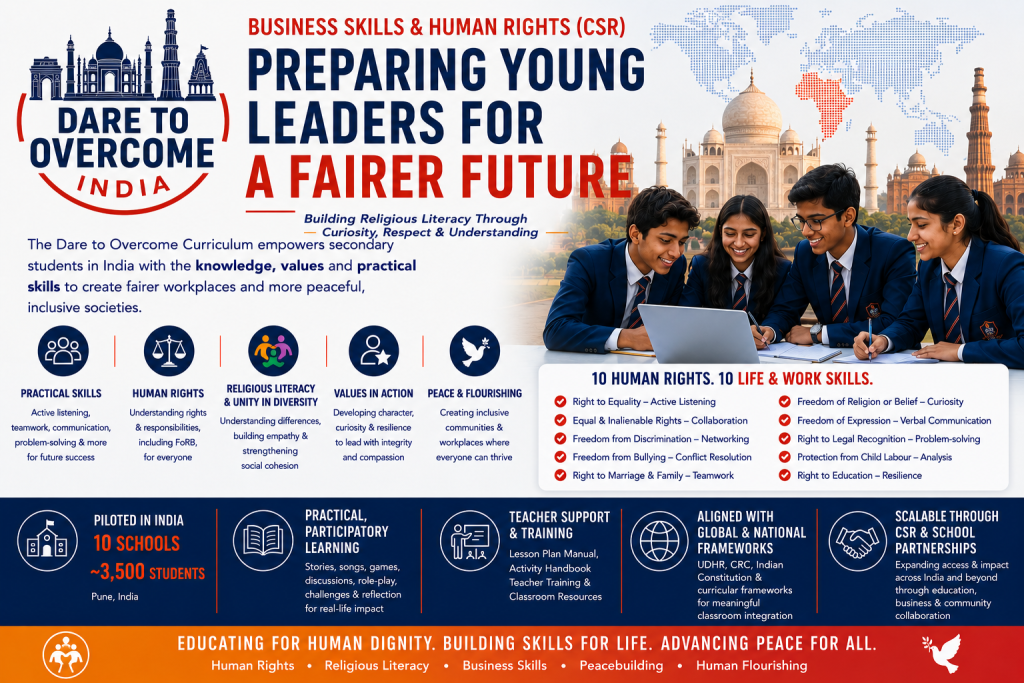
The curriculum emerged from the Religious Freedom & Business Foundation’s and Dare to Overcome’s broader work promoting human dignity, social cohesion, and human flourishing through business, education, and peacebuilding. Working in partnership with the MIT World Peace University (MIT-WPU) School of Education in Pune, India, the initiative adapted an existing human rights education resource into a new curriculum that would resonate with schools, students, and teachers while addressing contemporary social and economic realities.
The result was the Dare to Overcome Curriculum: Human Rights, Business Skills & Peace for Secondary School Students. The curriculum was piloted in ten schools in Pune and reached approximately 3,500 students. It was developed and implemented in collaboration with MIT-WPU faculty and student teachers, creating both student-learning and teacher-development outcomes.
What makes the curriculum distinctive is its integration of human rights education with practical business and communication skills. Rather than teaching rights as abstract legal concepts, each lesson pairs a specific human right with a skill that students can immediately apply in their lives. For example, the right to equality is paired with active listening, equal and inalienable rights with collaboration, freedom from discrimination with networking, freedom from bullying with conflict resolution, freedom of religion or belief with curiosity, freedom of expression with verbal communication, and the right to education with resilience.
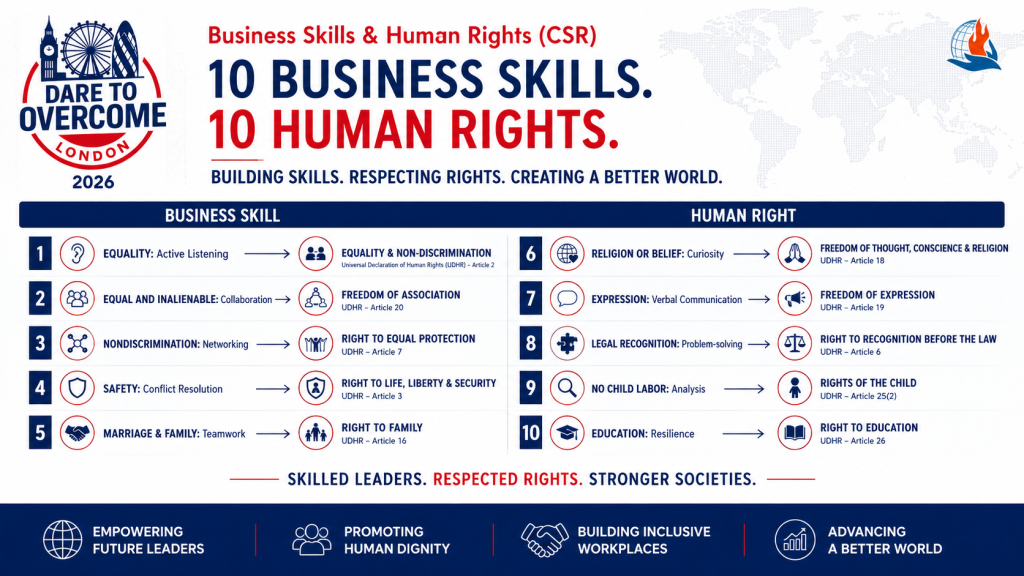
This approach helps students see that human rights are not simply principles to be memorized but values that can shape relationships, workplaces, communities, and societies.
The curriculum is built around the principle of Unity in Diversity—the idea that human dignity, equal rights, and peaceful coexistence can flourish while respecting differences in religion, belief, culture, language, and background. This principle is especially important in India, one of the world’s most religiously and culturally diverse societies.
Freedom of religion or belief is addressed most directly through lessons connected to Article 18 of the Universal Declaration of Human Rights. However, FoRB is not presented merely as a legal entitlement. Students are encouraged to explore how respect for religious freedom contributes to peaceful coexistence, social trust, and mutual understanding.
A distinctive feature of the curriculum is that FoRB is paired with the business skill of curiosity. Students learn that curiosity is not only a valuable workplace skill but also an important tool for engaging respectfully with people whose beliefs differ from their own. Through guided discussions and activities, students practice asking respectful questions, learning from others, and remaining open to new perspectives.
The curriculum also incorporates principles of Cross-Cultural Religious Literacy, encouraging students to seek understanding rather than agreement, avoid stereotypes, recognize diversity within religious traditions, and reflect on their own assumptions. This approach helps students engage differences constructively while strengthening social cohesion.
Classroom discussions include questions such as: “How can you respect the beliefs of others while practicing your own?” and “What values do most people share regardless of religion or belief?” These conversations help students connect FoRB principles to everyday life and relationships.
Classroom activities are designed to build religious literacy without requiring students to defend, justify, or disclose personal beliefs. Activities such as Religious Freedom Bingo, the Respect-o-Meter, and the Wheel of Peace help students explore different religious traditions, identify shared values, and appreciate diversity in a constructive and non-competitive way. The focus is not on evaluating religions but on understanding difference and cultivating respect.
The curriculum uses a highly participatory methodology. Lessons combine storytelling, songs, discussions, role-play, reflection exercises, games, worksheets, group challenges, and peer learning. Students are regularly encouraged to apply what they learn beyond the classroom through practical challenges and community-oriented activities, then reflect on and report back about their experiences. These real-world application challenges help transform human rights learning from theory into practice.
The curriculum connects strongly with both international and domestic legal frameworks. Students are introduced to the Universal Declaration of Human Rights (UDHR), selected principles from the Convention on the Rights of the Child (CRC), and relevant provisions of the Indian Constitution. Human rights concepts are therefore situated within both global and national frameworks, helping students understand that rights are universal while also finding expression in local legal and cultural contexts.
To support implementation in formal educational settings, the project includes a comprehensive Lesson Plan Manual, an Activity Handbook for Teachers, and teacher-training support developed through the MIT-WPU School of Education partnership. The curriculum was intentionally designed to be adaptable to different cultural and educational contexts while maintaining its core commitment to human dignity, human rights, peacebuilding, and practical skill development.
The longer-term vision extends well beyond the initial pilot. Because the curriculum combines human rights education, practical workplace skills, teacher-training resources, and CSR engagement opportunities, it provides a model that can be adapted for diverse educational settings. The framework was intentionally designed for replication and contextual adaptation, creating opportunities for expansion throughout India and potentially into other countries facing similar challenges related to diversity, inclusion, and social cohesion.
The curriculum also aligns with United Nations Sustainable Development Goal 16: Peace, Justice and Strong Institutions, reflecting a broader commitment to building more peaceful, inclusive, and resilient societies. Through future partnerships with schools, businesses, foundations, and community organizations, Dare to Overcome hopes to expand access to this model and help equip more young people with the skills and values needed to thrive in an interconnected world.
At its heart, the project is based on a simple conviction: young people should be equipped not only with knowledge but also with the skills and values needed to build a more just and flourishing world. By connecting freedom of religion or belief, human rights, peacebuilding, cross-cultural understanding, and practical workplace skills, the Dare to Overcome curriculum offers a new model for preparing young people to lead with competence, character, and compassion. In doing so, it demonstrates how education can help build not only successful careers, but also more peaceful, inclusive, and flourishing societies.
Building Religious Literacy Through Curiosity, Respect, and Understanding.