
Why dignity, purpose, and belonging must be at the heart of any serious rethinking of work, wealth, and wellbeing.
By Brian Grim, Ph.D.
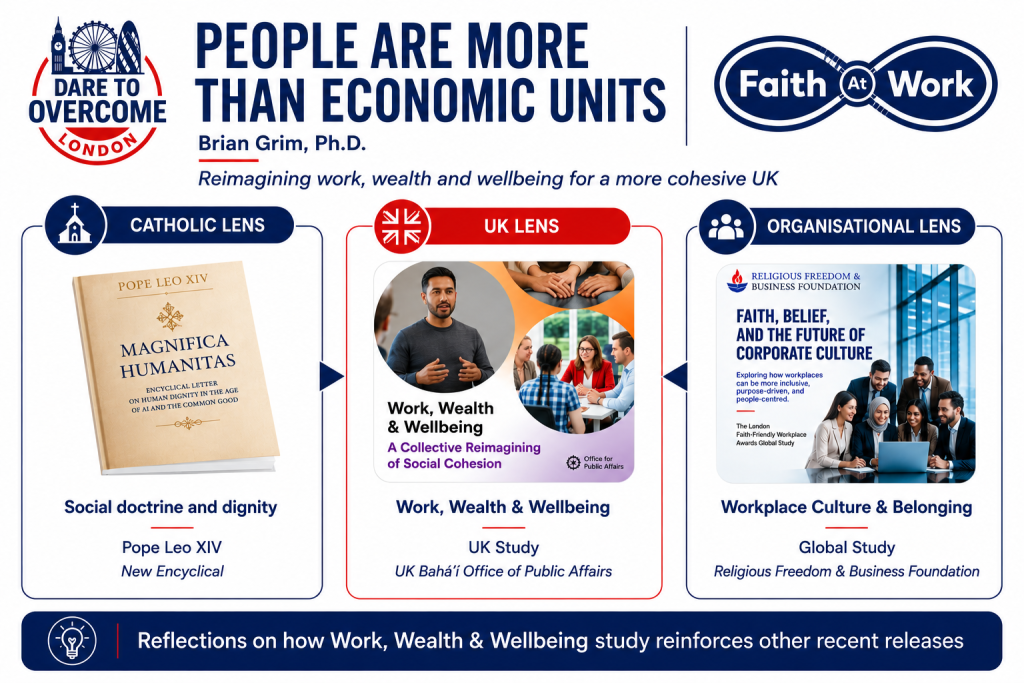
Reflections on the new report released by UK Bahá’í Office of Public Affairs, Work, Wealth & Wellbeing: A Collective Reimagining of Social Cohesion, being launched in the UK Parliament on 1st June 2026.
Britain’s social fractures are no longer easy to ignore. Rising inequality, fragile trust in institutions, loneliness, and a growing sense of social distance have left many people wondering what, exactly, is holding society together. The deeper question is not only economic. It is cultural and moral. What kind of society are we building when people are valued mainly for output, income, or status, rather than for their inherent worth and their capacity to contribute?
That is why Work, Wealth & Wellbeing: A Collective Reimagining of Social Cohesion is so timely. The report argues that stronger social cohesion will require more than policy reform alone. It will require a broader understanding of value, one grounded in four interlocking principles: Value, Purpose, Participation, and Collaboration. In that vision, people flourish when they are recognised as intrinsically valuable, trusted with responsibility, and connected to something larger than themselves.
Four organising principles for reimagining work (both paid and unpaid), wealth, and wellbeing emerged from the report:
- — Value
- — Purpose
- — Participation and Contribution
- — Collaboration
Two other recent texts reinforce that message from different angles. Pope Leo XIV’s encyclical Magnifica Humanitas offers a moral grammar rooted in dignity, solidarity, subsidiarity, and the common good. The Religious Freedom & Business Foundation’s Faith, Belief, and the Future of Corporate Culture adds a workplace lens, showing that trust, integrity, belonging, and purpose are increasingly central to healthy organisations. Taken together, these three perspectives suggest that social cohesion is built not only by systems, but by whether people feel seen, trusted, and able to contribute meaningfully to a shared life.
“Contrary to economic theories that portray human beings as primarily selfish, competitive, and motivated chiefly by personal gain, there is growing recognition that human beings are also deeply motivated by meaning, contribution, and connection to others.” — Work, Wealth & Wellbeing
Where Belonging Becomes Real
The first issue is where the foundations of social cohesion are actually being formed. In practice, they seem to emerge most clearly in places where people are treated as contributors rather than as passive recipients. The Bahá’í report’s strongest examples come from local community initiatives, youth programmes, and values-based workplaces where people are consulted, encouraged to act, and given a meaningful role in shaping outcomes.
The wider UK picture broadly confirms this. In England, many adults still report a sense of belonging to their immediate neighbourhood, yet trust in neighbours is markedly weaker. That is a revealing difference. Local attachment remains, but the trust that turns proximity into cohesion is much thinner. At the same time, most adults still see their local area as a place where people from different backgrounds get along well together, which suggests there is still a real social base on which to build.
Pope Leo’s encyclical offers a compelling image for this challenge. In contrasting Babel with the rebuilding of Jerusalem, he highlights the difference between a society built through power and uniformity and one rebuilt through shared responsibility, plurality, and cooperation. That is strikingly close to the UK report’s vision. Cohesion grows where people help rebuild the walls together, not where they are simply managed from above.
How Institutions Earn Trust
A second question is what institutions can do to help people feel valued, trusted, and able to contribute. The best answer is that they must provide structure without suffocating participation. The Bahá’í report shows this in practice. In Sheffield, a community-building initiative enabled young people to identify problems and organise responses around health and wellbeing. In London, a youth internship model linked work experience with service and character development. At Apax, a social enterprise in supported housing, staff contribute through regular reflection meetings and shared ownership of the organisation’s development.
This lesson is echoed in recent UK thinking on trust and public engagement. Public trust in political institutions has been declining, and effective public engagement can help restore legitimacy when it is transparent, inclusive, accessible, timely, and linked to actual decision-making. Poor engagement, especially where participation feels tokenistic or disconnected from outcomes, can deepen distrust. Legitimacy depends not only on what is delivered, but on whether people believe their involvement matters.
Pope Leo frames the same issue through subsidiarity. Higher authorities, he argues, should support the initiative of persons, families, associations, and communities rather than replace them. Institutions strengthen cohesion not when they do everything themselves, but when they enable others to act with dignity and responsibility. The Religious Freedom & Business Foundation adds that the same is true inside organisations. Workplaces build trust when people are treated as whole persons, capable of bringing meaning, conviction, and service into their work, not merely as performers of tasks.
Agency, Not Dependency
The policy question, then, is what kinds of approaches cultivate agency rather than dependency. Here, the Bahá’í report is refreshingly clear. It argues for policies that develop capacity, recognise diverse forms of contribution, and invest in the infrastructure of participation. In particular, it calls for public services to support people’s long-term potential and social contribution, not only their speed of return to the labour market. It also insists that unpaid care, volunteering, and relational work should be recognised as part of society’s real wealth.
That matters because participation is not evenly distributed. Volunteering remains lower than it was a decade ago, and participation is significantly lower in more deprived areas than in less deprived ones. Agency, in other words, is not simply a matter of attitude. It depends on whether the conditions of life make contribution possible.
Pope Leo reinforces this through solidarity and subsidiarity together. He argues that systems should create room for people, families, schools, associations, and communities to carry real responsibility. The Religious Freedom & Business Foundation makes a parallel point in corporate life. Institutions are strongest when they recognise people not just as economic resources, but as bearers of ethical agency, meaning, and responsibility.
Why Meaning Still Matters
Another major issue is the place of meaning, contribution, and service in shaping economic and social behaviour. Too often, modern debate treats these as nice extras, morally appealing perhaps, but secondary to productivity or growth. All three reports suggest the opposite. Meaning and service are not marginal to flourishing. They are part of its foundation.
The Bahá’í report repeatedly shows that purpose grows when people experience their efforts as contributing to something larger than themselves. In its case studies, commitment deepens when individuals see their work or service as socially meaningful. Pope Leo says much the same in theological language, describing work as a sphere of human freedom, creativity, and cooperation, not merely a mechanism for earning income. He warns against societies that judge people mainly by what they produce.
The Religious Freedom & Business Foundation brings that insight into the workplace. Its report argues that technology cannot replace the human need for meaning, trust, purpose, dignity, and belonging. It also finds that leading organisations increasingly rely on values such as integrity, collaboration, responsibility, and people focus. In other words, meaning is not a distraction from serious institutional life. It is one of the things that makes serious institutional life possible.
Young People and the Search for Purpose
Perhaps nowhere is this more visible than among younger generations. In the UK, many young people are not only looking for employment. They are also looking for belonging, purpose, and a sense that they can contribute meaningfully. Recent government work with young people in England shows intense concern about money, mental health, safety, work, and housing. It also shows a strong desire for safe and affordable places to gather, trusted adults, practical life skills, meaningful work experience, and a genuine voice in decisions that affect them.
The supporting data underline how urgent that is. Younger adults are more likely than older age groups to report loneliness and lower hope for the future. Questions about work, agency, and belonging are not separate issues for younger people. They are intertwined.
The Bahá’í report suggests that youth purpose is strengthened when work, service, and identity are connected rather than split apart. Pope Leo’s encyclical deepens that by insisting that development must be integral, not merely economic. And the Religious Freedom & Business Foundation shows that workplaces, too, are healthiest when they give people a sense that what they do matters beyond output alone.
From Participation to Shared Responsibility
The final challenge is how collaboration becomes more than a slogan. People move from passive participation to active contribution when they are listened to, trusted with responsibility, and able to see that their voice has consequences. The Bahá’í report is especially strong on this. Its recurring pattern is consultation, action, and reflection. Collaboration becomes cultural when it is structured, repeated, and connected to shared learning.
Pope Leo offers a parallel framework. He links solidarity with active participation in shared decisions and subsidiarity with decision-making as close as possible to those affected. The Religious Freedom & Business Foundation adds that collaboration flourishes where trust, belonging, integrity, and people focus are embedded into the rhythms of organisational life. Across all three, the lesson is remarkably consistent: collaboration becomes real when it is routinised, resourced, and lived out through relationships.
Britain’s question, then, is not simply whether it can restore social cohesion through better policy. It is whether it can recover a fuller understanding of the human person. These reports suggest that repair will come not from seeing people as economic units to be managed, but as persons with dignity, purpose, and a capacity to contribute to the common good. That is a demanding vision, but also a hopeful one. It reminds us that social cohesion is not something we inherit automatically. It is something we build, weaken, or rebuild through the ways we value one another, structure our institutions, and imagine the good of the society we share.
For those who would like to explore these ideas more fully, I invite you to join us at Dare to Overcome: The Economics of Kindness in London, 12–16 October 2026. You can learn more here: Dare to Overcome London 2026.