

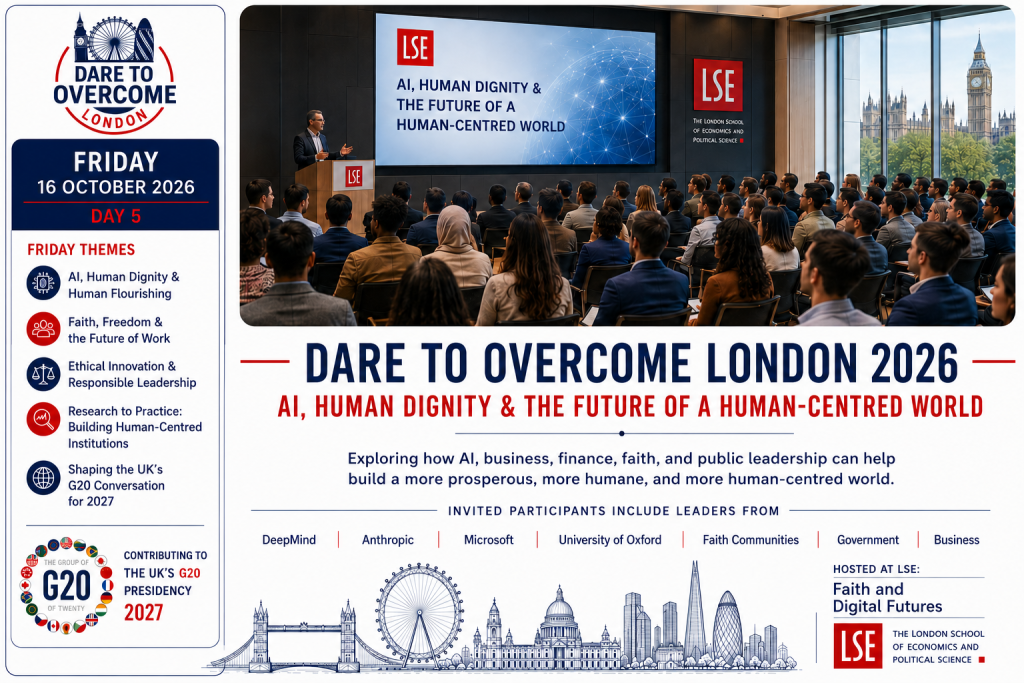
16 October 2026 – Friday
As part of the Dare to Overcome London 2026 series, the event “AI, Human Dignity, and the Future of a Human-Centred World” will bring together voices that rarely share the same platform. Hosted at the London School of Economics and Political Science (LSE) and coordinated by Dr. Tomislav Karačić, Assistant Professor of Information Systems in LSE’s Department of Management, the gathering aims to move beyond the familiar debates of technological disruption toward a deeper question: What kind of society are we building, and for whom?

9:00-9:15 Opening:
- Tomislav Karačić, PhD, Assistant Professor of Information Systems in LSE’s Department of Management; Faith and Digital Futures
- Brian Grim, PhD, President, Religious Freedom & Business Foundation; Global Chair, Dare to Overcome; Associate Director, Faith@Work UK
9:15-10:00 Building Human Dignity Through Institutions: Religion, Work, and the Future of Inclusion
Drawing on a landmark special issue of the International Journal for Religious Freedom, this panel explores how businesses, civil society organizations, employee networks, trade unions, faith communities, and legal advocates serve as “intermediate actors” that translate human dignity and freedom of belief into everyday workplace realities. Read more.
- Alexandra Cosima Budabin, PhD, Senior Researcher, Eurac Research
- Constance Nardocci, Associate Professor, University of Milan
- Adelaide Madera, Associate Professor, University of Messina (TBC)
- Brian Grim
10:00-10:45 Board Perspective on Faith & AI
This panel will introduce the the Board Paper on human character, corporate governance and long-term value released this week at Dare to Overcome: The Overlooked Source of Human Capability and Character: Why Faith and Belief Matter in the Age of Artificial Intelligence
- Austin Tiffany, PhD, Senior Director at Good Faith Partnership, leading international projects and research on society and religion for social good
- Brian Grim
10:45 – 11:45 AI and human flourishing
- Harris Boor PhD — Barrister at Twenty Essex, Chair at AI and Faith, Commissioner at AI Faith & Civil Society Commission
- Dr. Viva Ona Bartkus, is a business professor emerita at Norte Dame University. She has been doing work on poverty alleviation, human dignity, and peace through business development for the last few decades.
- Matt Downs is an investor and collaborator in social-impact staffing efforts throughout the world. Currently serving as the CEO of Pearl27, a digital marketing firm that applies AI with human-in-the-loop content and coordination.
- Sir Robert Buckland – legal, policy
- Dr Carmody Grey — Durham University (TBC)
11:45-12:45 Keynote
Professor Lord (Lionel) Tarassenko CBE FREng FMedSci — President of Reuben College; world-leading expert in the application of signal processing and machine learning to healthcare, with a strong track record in translation to clinical medicine.
12:45-13:45 Lunch
13:45:14:45 AI and faith organizing
- Andrea Cabanas – practitioners
- Fr Michael Baggot LC — professor of bioethics at Pontifical Athenaeum Regina Apostolorum
- Naoise Graham – bishops’ conference
- Dr Sarah Bana — LSE ; faith, economics, Ismaili framework
14:45-15:45 Leadership in the age of AI
- Iqbal Nasim — Former Chief Executive of the National Zakat Foundation
- Ihab El Ghazzawi – Dell Technologies. He partners with C-suite leaders, customers and global teams to define AI strategies, shape go-to-market initiatives and lead transformation programmes that drive growth, improve customer experiences and build high-performing organisations.
- Phil Carmack is an AI expert, having served as a Vice President at both Nvidia and Google as well as CEO of multiple tech companies and inventing key semi-conductor chips. He is not only knowledgeable but can communicate in an understandable way with the technical and non-technical audiences.
15:45-17:00 Networking
We will explore themes including:
- AI, human dignity, and human flourishing
- Faith, freedom, and the future of work
- Ethical innovation and responsible leadership
- Translating research into practice through human-centred institutions
- Contributing ideas to the United Kingdom’s G20 Presidency in 2027
What makes this event distinctive is its commitment to interdisciplinary dialogue. Contributors are being invited from leading technology companies, major universities, public policy institutions, and faith communities. The goal is not simply to discuss AI, but to examine how technological progress can advance the common good while respecting the diversity of human beliefs, values, and experiences.
Among the perspectives being explored are questions about how technology companies engage religious communities, what it means to bring one’s faith or worldview into the workplace, and how faith traditions might contribute to broader conversations about AI ethics, governance, and social responsibility.
The event also reflects a broader vision behind the Dare to Overcome movement. As artificial intelligence transforms economies and institutions, the challenge is not simply to build more powerful technologies, but to foster a world in which innovation strengthens human relationships, expands opportunity, and promotes human dignity.
The future will be shaped not only by the capabilities of machines, but by the values of the people who design, regulate, deploy, and live alongside them.
Drawing on a landmark special issue of the International Journal for Religious Freedom, this panel explores how businesses, civil society organizations, employee networks, trade unions, faith communities, and legal advocates serve as “intermediate actors” that translate human dignity and freedom of belief into everyday workplace realities. The discussion will examine emerging research on religious accommodation, inclusion, and freedom of conscience across Europe, North America, and Africa, including the role of employee resource groups, civil society organizations, faith leaders, and businesses in navigating diversity in increasingly complex workplaces.
As artificial intelligence reshapes organizations and economies, the panel will ask a broader question central to the future of a human-centred world: which institutions and intermediate actors can ensure that technological progress strengthens rather than diminishes human dignity, belonging, and freedom? And how can these entities support religious minorities who may experience AI-derived human rights violations?
Speakers:
- Alexandra Cosima Budabin, PhD, Senior Researcher, Eurac Research
- Constance Nardocci, Associate Professor, University of Milan
- Adelaide Madera, Associate Professor, University of Messina
- Brian Grim, Ph.D., President, Religious Freedom & Business Foundation
Panel B: AI and Future of Work
The Overlooked Source of Human Capability and Character Why Faith and Belief Matter in the Age of Artificial Intelligence
- Brian Grim, PhD, President, Religious Freedom & Business Foundation
- Austin Tiffany, PhD, Senior Director at Good Faith Partnership, leading international projects and research on society and religion for social good
On 16 October in London, that conversation begins with a simple but profound conviction: technology should serve humanity—not the other way around.
Dare to Overcome London 2026
Friday, 16 October 2026
London School of Economics and Political Science
Theme: AI, Human Dignity, and the Future of a Human-Centred World